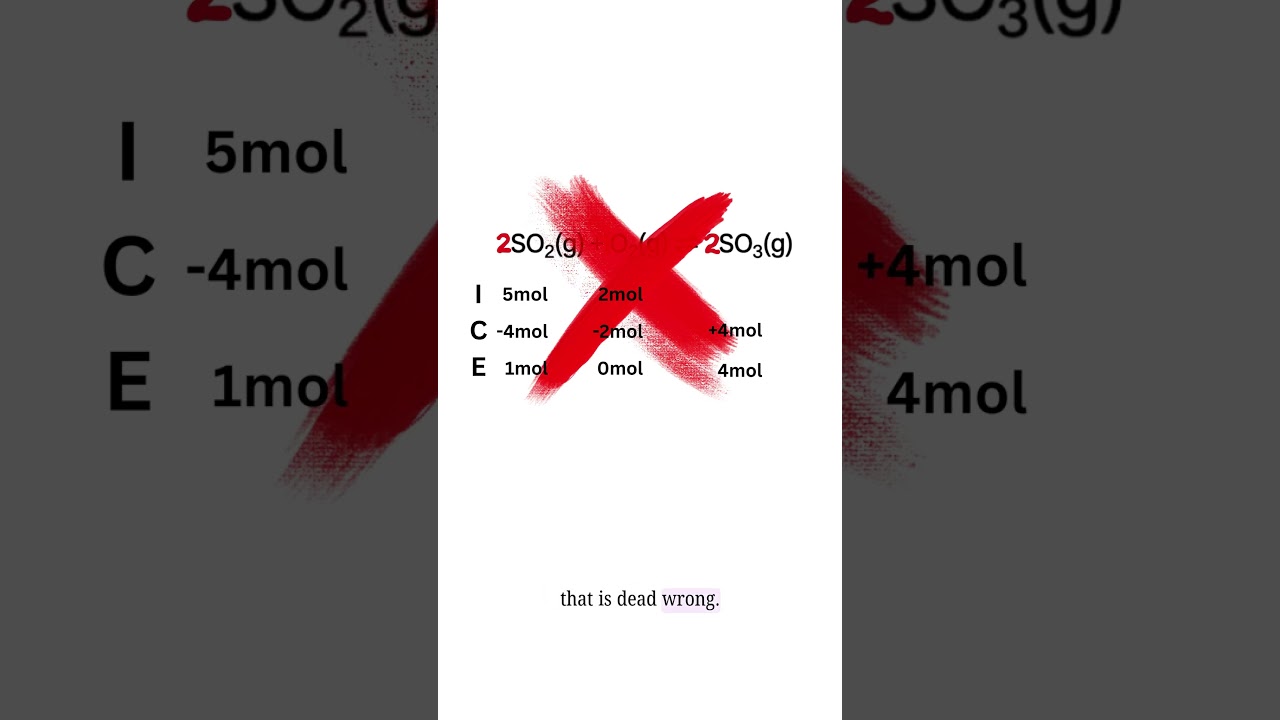
Thinking that reactants always react completely is a common mistake in chemistry. This video explains why stoichiometry works differently in equilibrium reactions and how to use an "ICE Table" to find the exact amounts of substances remaining.
🔗 Reference Video: Watch on YouTube
In a reversible reaction, putting in 2 moles of SO2 and 1 mole of O2 doesn't simply result in 3 moles of SO3. Assuming reactants are completely used up is a logical trap because equilibrium reactions never reach zero.
To find out exactly how much reacts, you need the Equilibrium Constant. Because of the reversible arrows, reactants exist alongside products, and their final concentrations are governed by the constant K.
Since we don't know the exact change, we set the amount of O2 reacted as 'x'. Following the 2:1:2 ratio, SO2 decreases by 2x, O2 by x, and SO3 increases by 2x. This gives us the equilibrium values: (5-2x), (2-x), and 2x.
Using the formula (Products / Reactants) and the coefficients as exponents, we solve for 'x'. With K=10, x is approximately 1.64. Substituting this back, we find that some reactants (0.36 mol O2 and 1.72 mol SO2) still remain even after the reaction.