Just a little more posting, and the 2019 AP Chemistry series will be finished.
The audio echoes quite a lot because I am not using a separate microphone.
I am recording with the computer’s built-in microphone. Haha.
I hope this helps, even a little. Thank you.
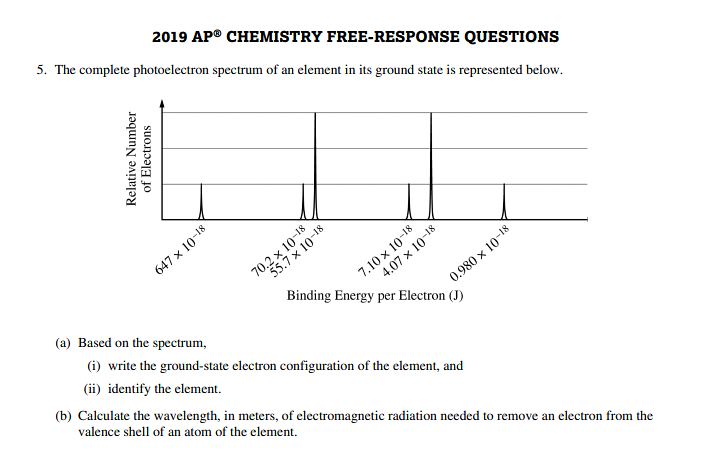
a. 1s² through 4s²: 1s² 2s² 2p⁶ 3s² 3p⁶ 4s².
b. Ca — calcium.
c. E = hν.
0.980 × 10⁻¹⁸ J = (6.626 × 10⁻³⁴ J s)ν.
ν = 1.4790 × 10¹⁵ Hz.
c = νλ.
λ = (3.00 × 10⁸ m/s) / (1.4790 × 10¹⁵ Hz).
λ = 2.03 × 10⁻⁷ m.
There is not much to work through in Question 5. It does not even require an extended written answer.
Parts a–c are straightforward, so I am recording the next question too.
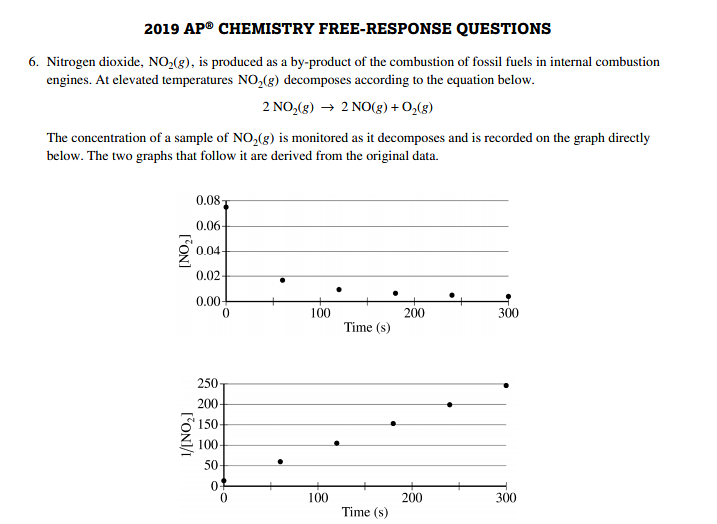
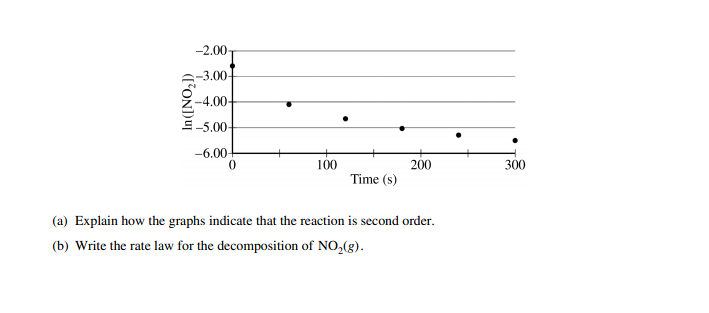
a. For a second-order decomposition, a plot of 1/[X] against time is linear. Since the graph here is linear, the reaction is second order.
b. The reaction is second order, so its rate law is rate = k[NO₂]².
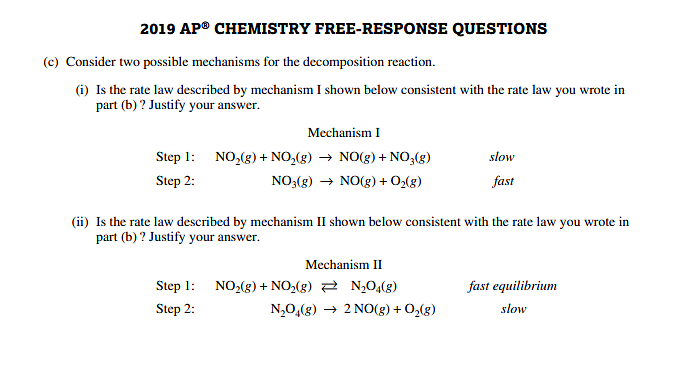
i. For an elementary step, molecularity determines the order with respect to each reactant. The slow step determines the overall rate. Mechanism I gives rate = k[NO₂]² for its slow step, consistent with part b.
ii. The second mechanism is also consistent with the rate law.
Keep studying hard. Just one more question remains in the 2019 AP Chemistry free-response set.
I am only doing one a day—perhaps I am being lazy. I could probably finish it in a day, but I am trying not to overdo it so I can keep posting consistently. After this, I will move on to 2018.