Before studying IB Chemistry or Biology, it is worth looking at the contents.
I have listed the topics below in order.
First are the core topics, followed by the additional HL material in the syllabus used at the time.
1. Stoichiometric relationships — 13.5 hours: calculations!
2. Atomic structure — 6 hours: orbitals, electrons, and related ideas.
3. Periodicity — 6 hours: ionization energy and related trends.
4. Chemical bonding and structure — 13.5 hours: VSEPR and more.
5. Energetics and thermochemistry — 9 hours: endothermic and exothermic processes are key examples.
6. Chemical kinetics — 7 hours: collision theory and related material.
7. Equilibrium — 4.5 hours: Le Chatelier’s principle is a representative topic.
8. Acids and bases — 6.5 hours: titration appears here.
9. Redox processes — 8 hours: including the Winkler method.
10. Organic Chemistry — 11 hours: perhaps the most interesting unit. Haha.
11. Measurement and data processing — 10 hours: errors and related concepts.
12. Atomic structure — 2 hours.
13. Periodicity — 4 hours, with a subheading concerning changes in substances.
14. Chemical bonding and structure — 7 hours.
15. Energetics and thermochemistry — 7 hours.
16. Chemical kinetics — 6 hours.
17. Equilibrium — 4 hours.
18. Acids and bases — 10 hours.
19. Redox processes — 6 hours.
20. Organic Chemistry — 12 hours.
21. Measurement and data processing — 2 hours.
Paper 1.
Multiple-choice questions cover the core and additional HL material, or core only for SL. In this exam format, SL students answer 30 questions in 45 minutes and HL students 40 in one hour. A periodic table is the only reference provided. Time is short, but there are not many questions, so read carefully and aim to get nearly all of them right.
Paper 2.
Short-answer and extended-response questions cover the same material as Paper 1: core plus additional HL, or core only for SL. SL lasts 1 hour 15 minutes and HL 2 hours 15 minutes. It is often held on the same day as Paper 1. A data booklet is provided.
Paper 3.
This paper uses experimental data and real-world applications, together with short-answer and brief written questions on an option. You need knowledge across the syllabus. SL lasts one hour and HL 1 hour 15 minutes. Answer the option you studied. A data booklet is provided.
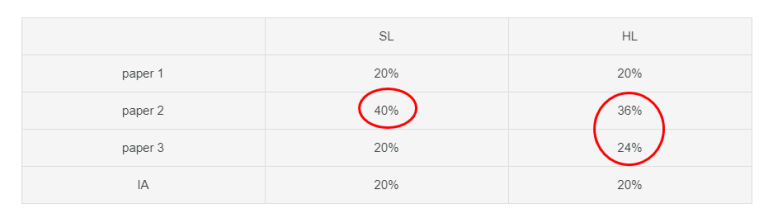
The differences between SL and HL are particularly noticeable in Papers 2 and 3. HL Paper 3 is not easy.
Work hard on Paper 3 while keeping up your Paper 1 practice.
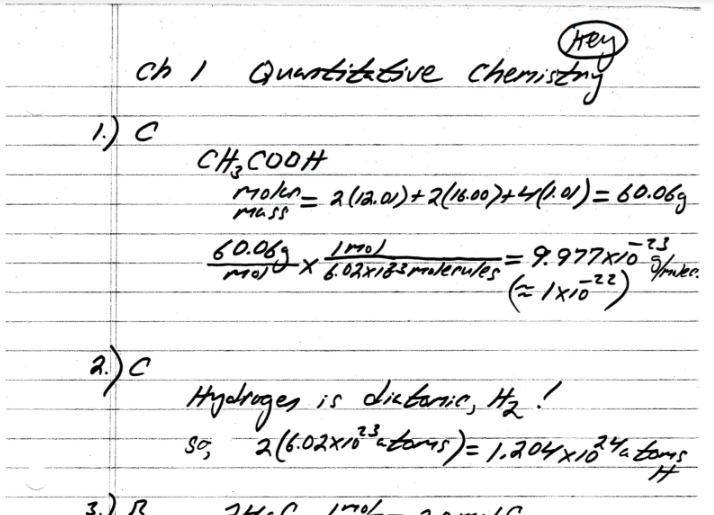
I should also mention the importance of the IA.
Choose a topic that interests you. As you read the textbook, look for ideas that could become a topic. If the experiment is too complicated, writing the IA becomes difficult, so avoid an overly ambitious project. Plan realistically whether you can actually carry out the experiment before you begin writing.
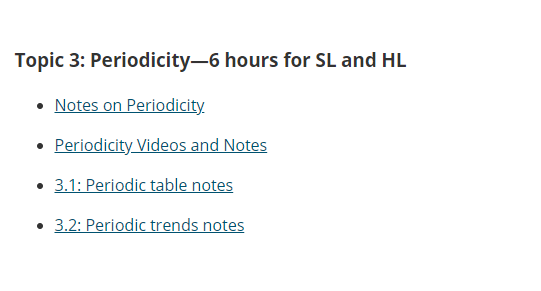
Some overseas websites provide free notes like these. Avoid scattering your attention across too many resources, but if you do not know where to start, free online lessons and textbooks can help.
Many of my students have earned the top IB Chemistry grade. In my experience, they solved plenty of questions and did not become overly ambitious about the IA. Once they chose a topic, they stayed with it instead of continually looking for another.
I recommend completing at least five years of past papers before the exam.