One of my lessons was canceled today, so I have a chance to write a post.
I had expected the format to change because this year’s exam is online.
However, College Board said the questions would be similar in style and difficulty to those on previous exams.
So I think you can continue preparing in the way you have been.
Above all, you need to work through plenty of past questions, right?
The free-response questions are among the most useful past-exam resources.
There are also actual past papers. If your access to materials is limited, working through the FRQs above is a good option.
Today’s post is for students who have only studied IB or SAT Chemistry.
I will go over areas of AP Chemistry that do not overlap with those two exams.
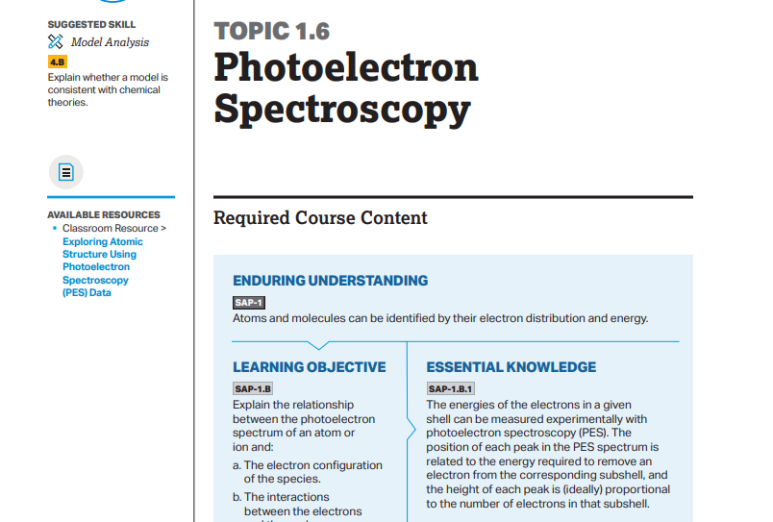
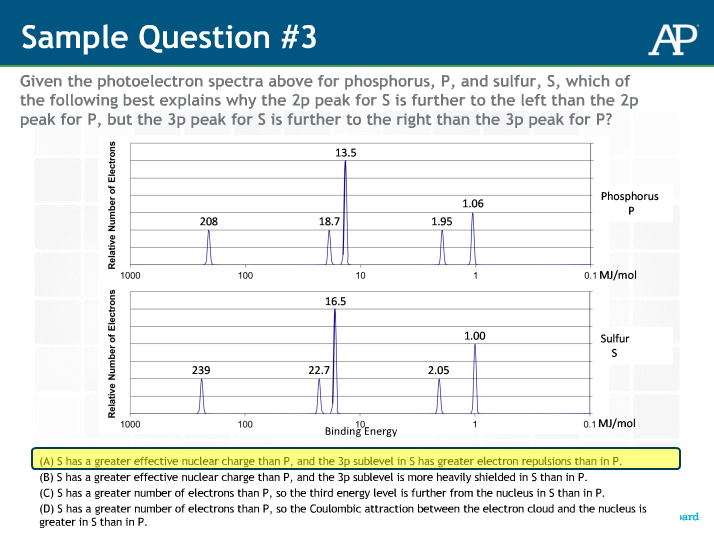
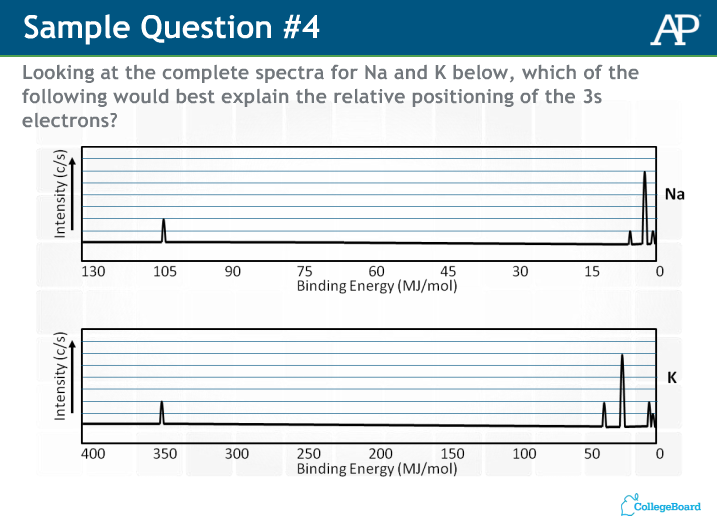
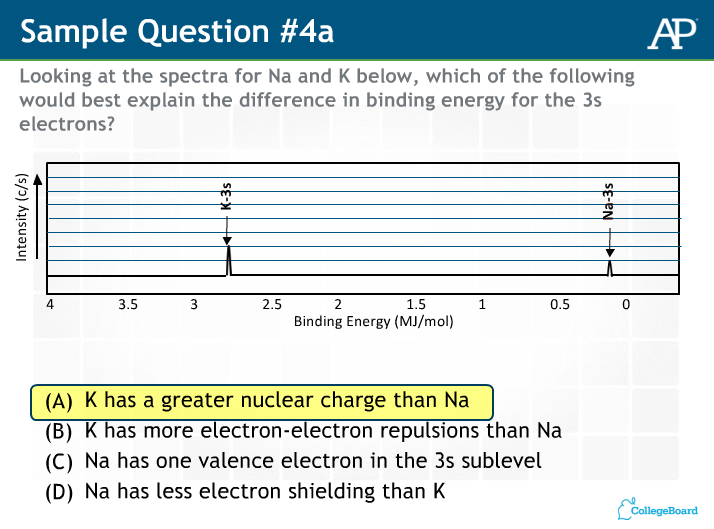
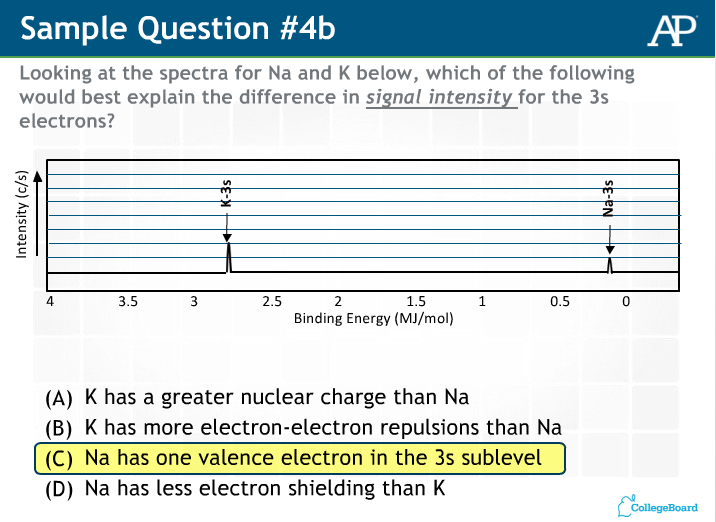
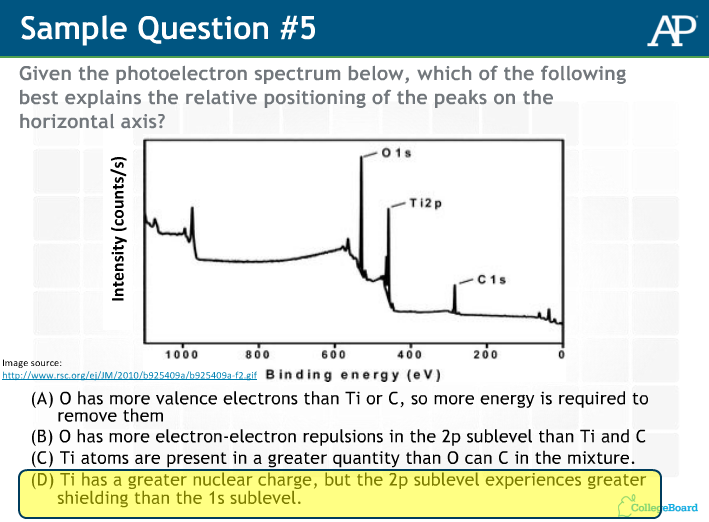
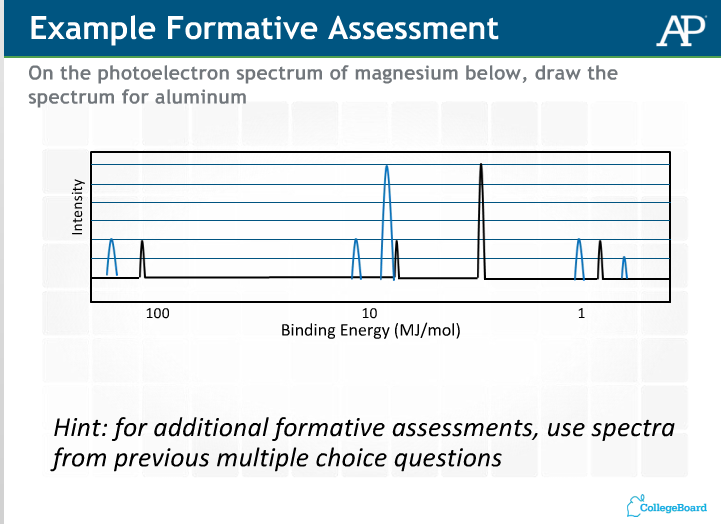
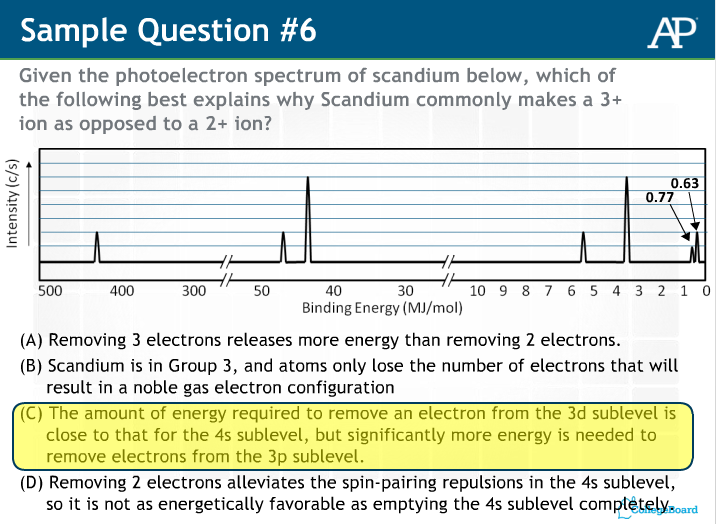
First is photoelectron spectroscopy. The essential knowledge describes how PES measures electron energies experimentally: a peak’s position relates to the energy required to remove an electron from the corresponding subshell, while its height ideally reflects the number of electrons represented. In simple terms, think of PES as showing the energy needed to pull electrons away.
Be sure to visit the site linked below and try its questions on this topic.
Historically, I have seen this topic come up every two or three years, so I think it could appear again.
The site is https://secure-media.collegeboard.org/digitalServices/swf/ap-webcasts/chemistry/ap_chem_pes.html.
https://secure-media.collegeboard.org/digitalServices/swf/ap-webcasts/chemistry/ap_chem_pes.html ↗secure-media.collegeboard.org
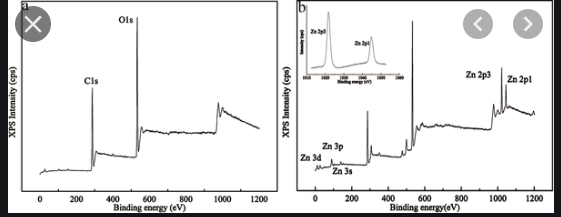
AP Chemistry PES Webcast - March 2014 secure-media.collegeboard.org ↗A harder question might show a graph like the one below.
The things you need to understand in this unit are (a) the electron configuration of the species and (b) interactions between the electrons and the nucleus. Study the spectrum in connection with both.
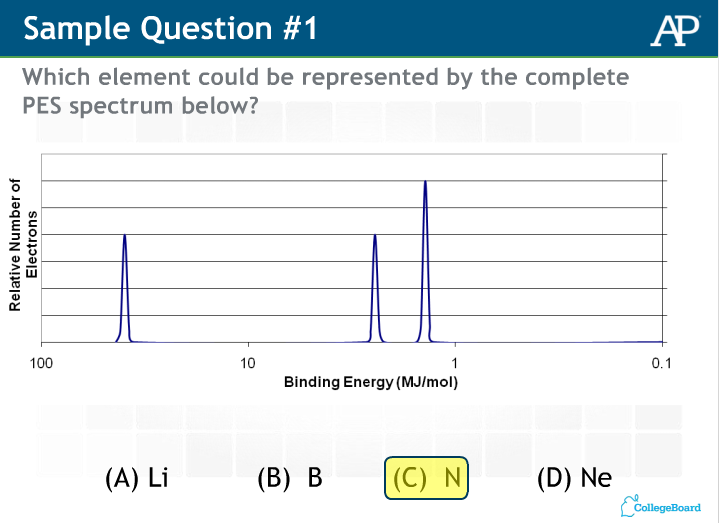
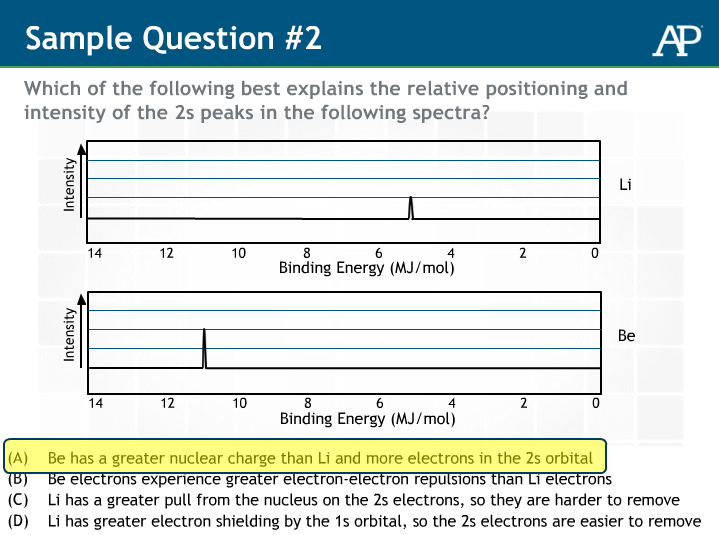
I will post some questions. Give them a try!
Next are alloys. This topic has not appeared for a while, and it has hardly appeared in free-response questions, so I suspect it may not come up. Still, many students find it unfamiliar, which is why I am including it. I do not consider it a major topic, but you never know where it might appear.
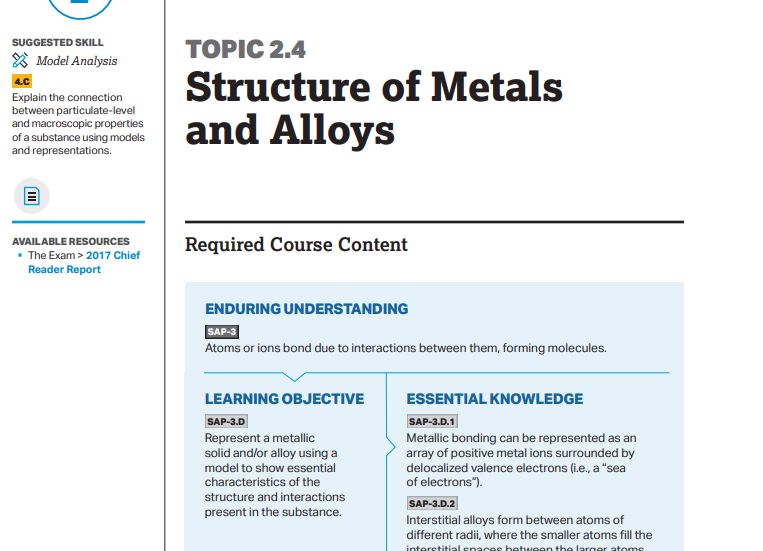
An interstitial alloy forms when atoms of different sizes combine and smaller atoms occupy gaps between larger atoms. Steel, with carbon in the spaces between iron atoms, is an example. The key is to identify this by atomic size. Remember steel as an alloy containing iron and carbon.
Compare that with a substitutional alloy: atoms of similar radii replace one another in the lattice. In some brass alloys, zinc replaces copper. Ultimately, the distinction is the difference in atomic sizes. Make sure you remember the examples given here.
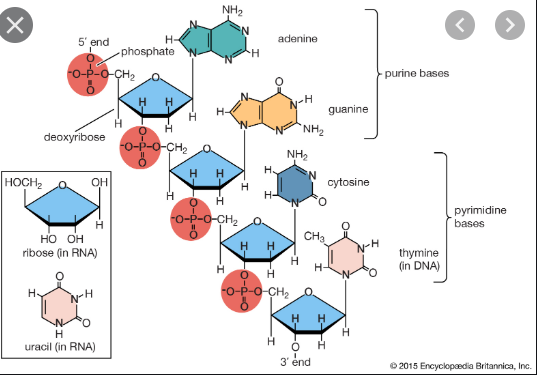
Next, biomolecules.
For example, a question might give you a large molecular structure and ask about its structure or hybridization.
It could also ask about intermolecular and intramolecular bonding.
In large biomolecules and polymers, noncovalent interactions can occur between separate molecules or between regions of the same molecule. These interactions strongly influence molecular shape, which in turn affects the molecule’s properties and function.
Next are deviations from the ideal gas law.
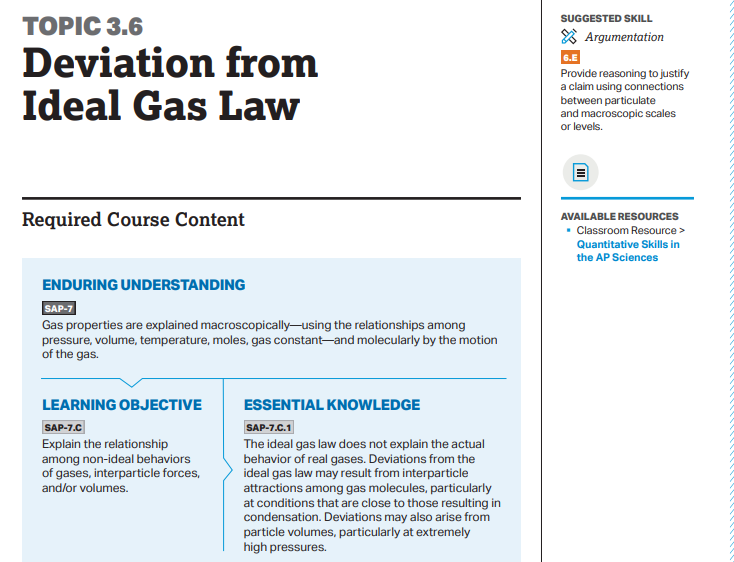
Questions may focus on interparticle forces and the volume occupied by particles. You need to study these and understand how real conditions differ from ideal-gas assumptions.
Here is some wording to help you study.
The ideal gas law does not fully describe real gases. Attractions between gas particles cause deviations, especially near conditions where condensation occurs. The particles’ own volume also matters, particularly at extremely high pressures.
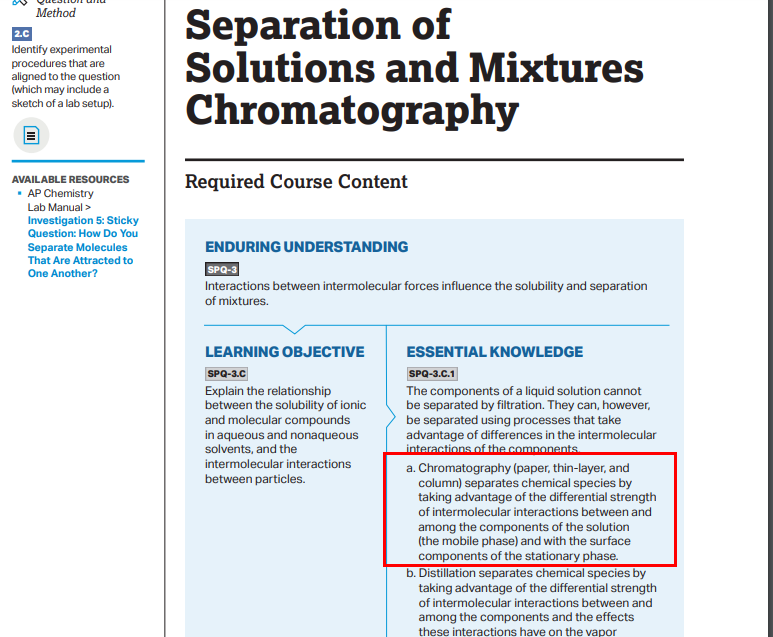
You should also study chromatography.
It has appeared a few times in FRQs and past papers. If you study those examples, you should get a clear sense of the question patterns.
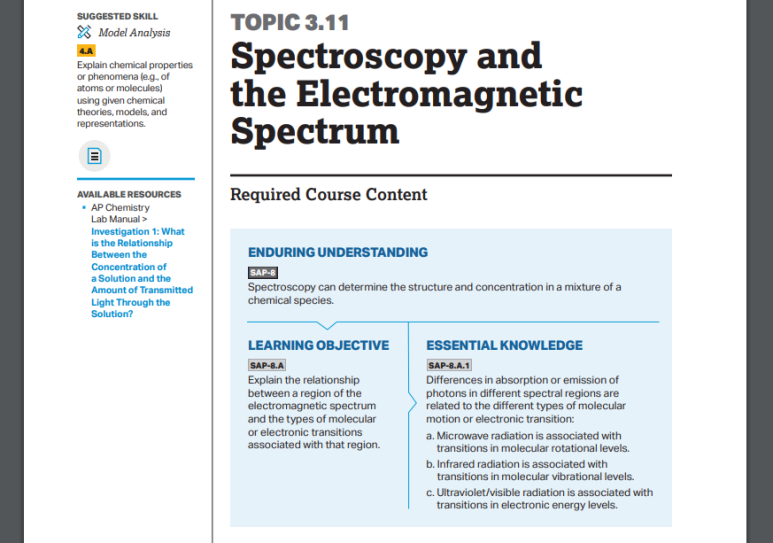
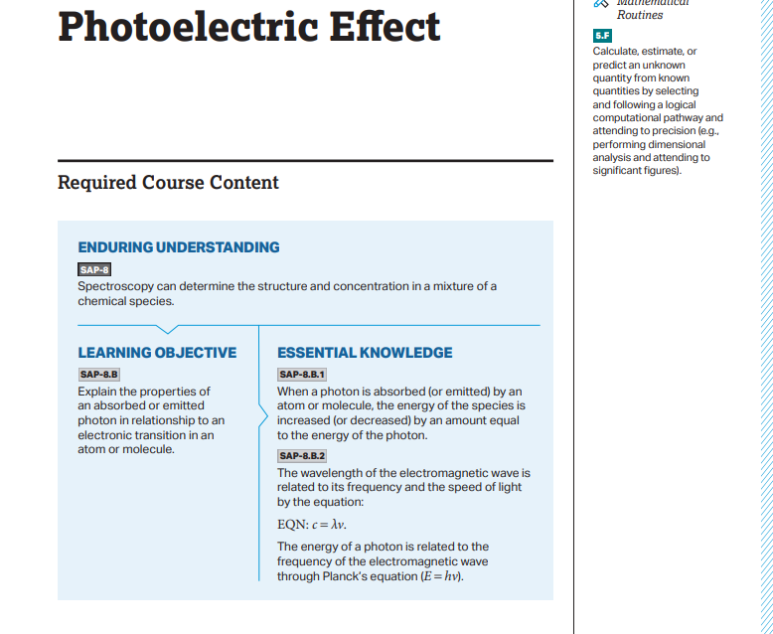
You need a clear understanding of the relationships between energy, wavelength, and frequency. This material often appears in a familiar form, so you should have plenty of opportunities to practice. Work through past questions and analyze how it may be tested.
The relationship between wavelength, frequency, and the speed of light is c = λν. A photon’s energy is given by E = hν. These questions have usually involved calculations, and I suspect that would also be the case this time. Other units often give energy in kJ/mol, whereas here you may need energy per particle. Be very clear about when to divide by 6.02 × 10²³.
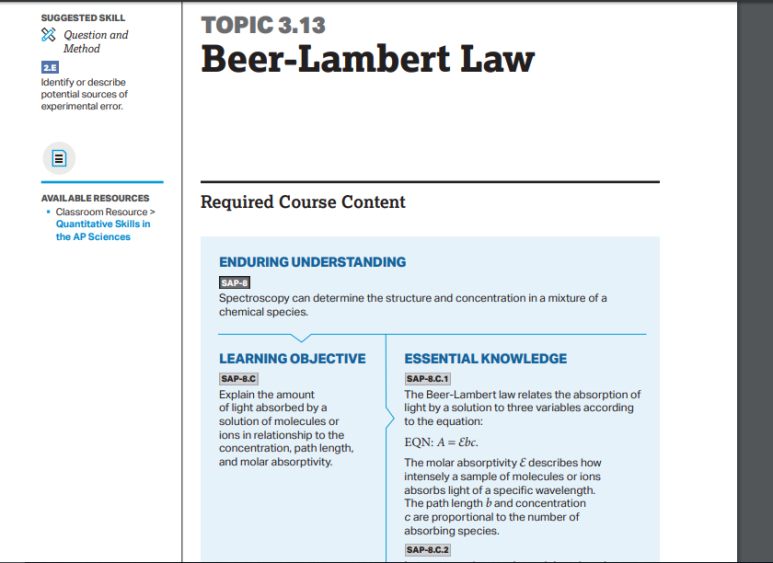
I think Beer–Lambert law is particularly likely to appear. In my experience it comes up roughly every two years, so seeing it this time would not be surprising. This is a topic to prepare thoroughly. Analyze the equation and know exactly what it means.
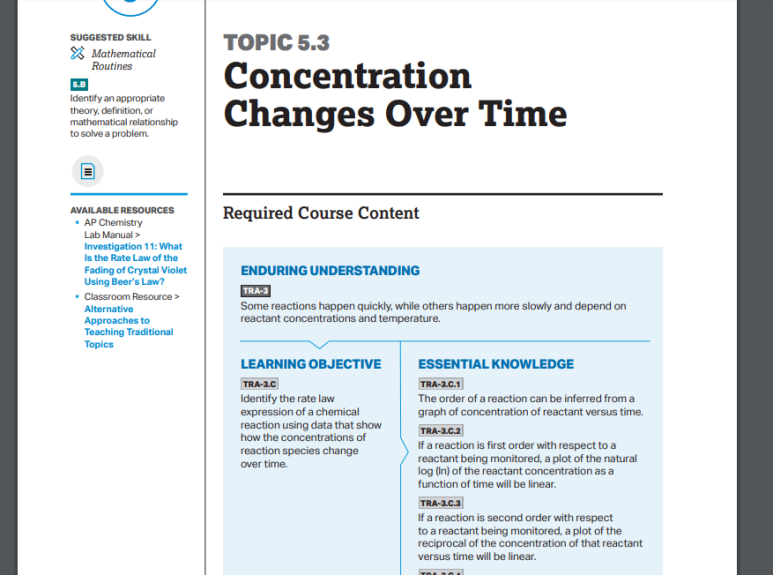
Reaction-rate graphs appear almost every year. They appeared in 2019, so I wonder whether they will appear again in 2020. AP Chemistry frequently asks students to use the slopes of the appropriate concentration–time plots to determine rate constants for zero-, first-, and second-order reactions. The integrated equations are [A]t − [A]0 = −kt, ln[A]t − ln[A]0 = −kt, and 1/[A]t − 1/[A]0 = kt, respectively. These could appear again, so learn to recognize the question types. The integrated rate equations seem to appear about once every three years.
I have covered some areas that are not usually emphasized in IB or SAT Chemistry. I did not select all of these because they are the most important topics; I included them because many students find them unfamiliar.
Please get in touch if you have questions. Thank you.
https://open.kakao.com/o/s1Vm7U5b ↗