A student asked me to explain how NAD⁺ becomes NADH. I had not often received that question, and it came during SAT II study, far beyond the required scope. I gave a rough verbal explanation, then added more by message. I am posting this to explain it more clearly.
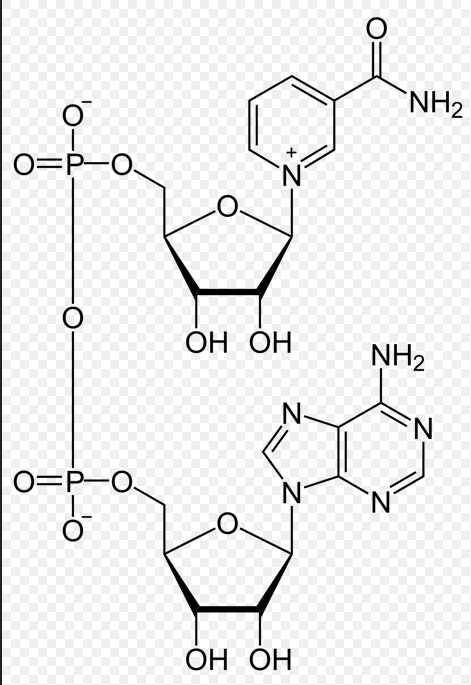
NAD⁺ has the structure shown above. It looks very complicated. Its name is nicotinamide adenine dinucleotide: a large molecule made from two linked nucleotides. Let us look at how it becomes NADH.
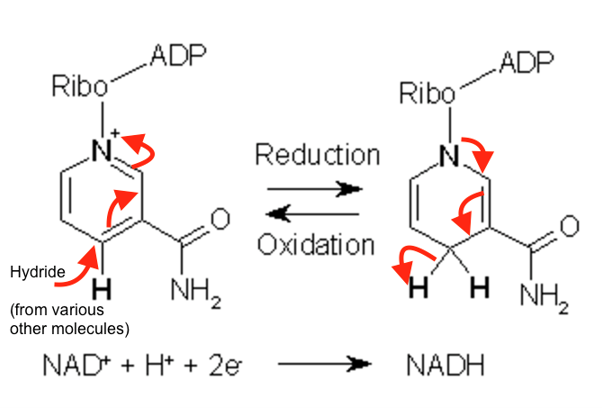
In this original explanation, I compared the reduction with ideas encountered in the Birch reaction in Organic Chemistry: a proton cannot simply attack the ring in the way imagined, and the discussion involves two electrons and hydrogen addition at the opposite ring position. This is only the analogy used in the post. There is no need to study that proposed mechanism in great depth for the AP, IB, or SAT II Biology courses discussed here; a brief look is sufficient.