The volume was too low in Question 1, so I have increased it considerably this time.
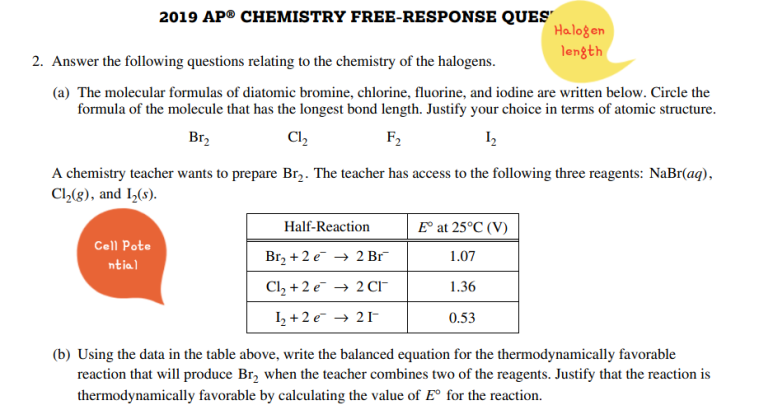
a. I₂: of the four molecules, its atoms are the largest. The bonding electrons are farther from the nuclei and experience weaker electrostatic attraction.
b. 2 Br⁻(aq) + Cl₂(g) → Br₂(g) + 2 Cl⁻(aq).
E°cell = 1.36 V − 1.07 V.
E°cell = 0.29 V.

c. Br₂ has London dispersion forces; BrCl has both dipole–dipole interactions and London dispersion forces. The dispersion forces in Br₂ are sufficiently stronger that its overall intermolecular attractions are greater.

d. PV = nRT; P = 1.22 atm.
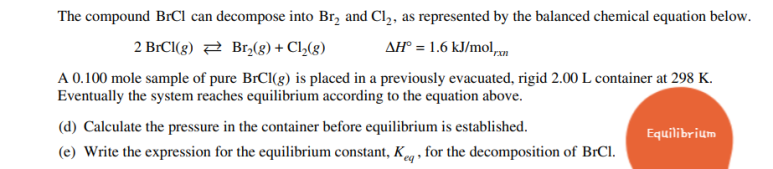
e. K = [Br₂][Cl₂] / [BrCl]².
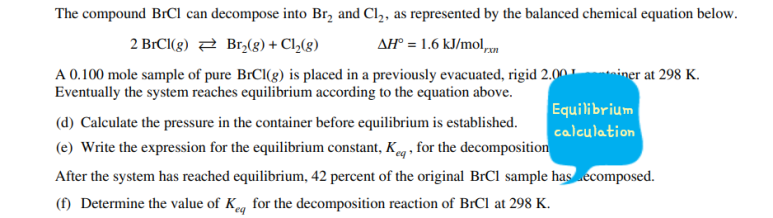
f. 0.131.
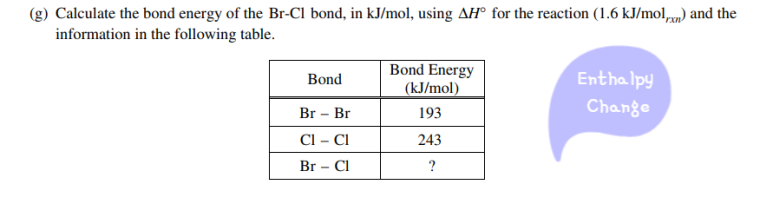
g. 217.2.