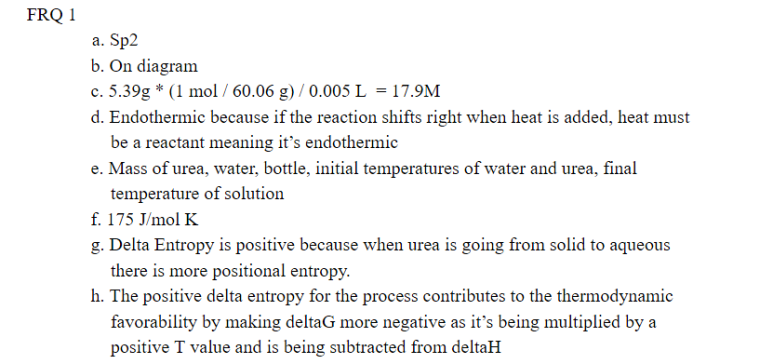
Here is Question 1.
I decided to post this rather suddenly, so the preparation is not perfect. I apologize.
An unusual number of visitors came today, so I had to pause the recording many times.
I also did not want the students to see me making the post, so I recorded quietly when they were not looking.
Sorry about that.
https://apcentral.collegeboard.org/pdf/ap19-frq-chemistry.pdf
You can download the 2019 FRQs above.
I am covering Question 1, which contains more than I expected. I was surprised that even the recording took 20 minutes.
I am sorry that I could not explain everything in depth.
https://apcentral.collegeboard.org/pdf/ap19-frq-chemistry.pdf ↗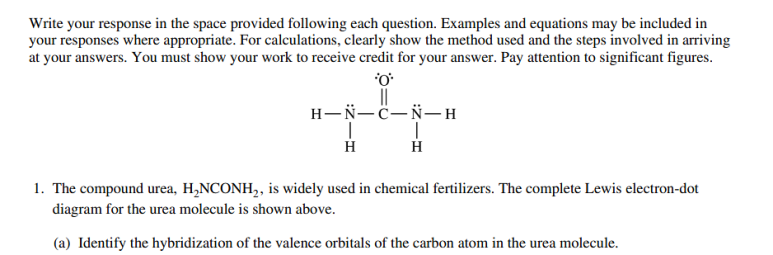
The first part asks about hybridization. See the explanation in the video.
I could not explain at length, so I briefly showed the method. The answer here is sp².
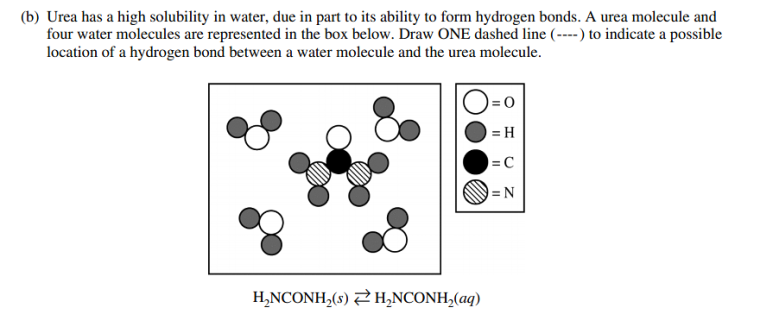
The second part asks you to draw a hydrogen bond. It concerns an intermolecular interaction involving hydrogen and N, O, or F.
There is a lot I would like to say about hydrogen bonding. Students often miss important points.
I will explain more when I have the opportunity.
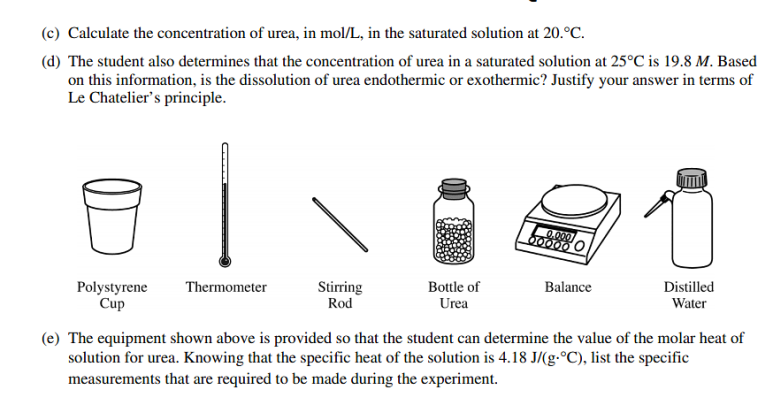
The third part concerns concentration, found using mol/L. Calculate moles from mass divided by molar mass, then divide by the given volume in liters. It is a straightforward substitution.
5.39 g × (1 mol / 60.06 g) / 0.005 L = 17.9 M.
The fourth part concerns Le Chatelier’s principle. I could not cover it broadly, so I gave a brief explanation in the video.
Endothermic: if adding heat shifts the process to the right, heat acts as a reactant.
The fifth part uses q = mcΔT. The listed measurements are the masses of urea, water, and the container; the initial temperatures of water and urea; and the solution’s final temperature. Urea mass gives its amount in moles, water mass enters the heat calculation, and the temperature measurements give the temperature change.
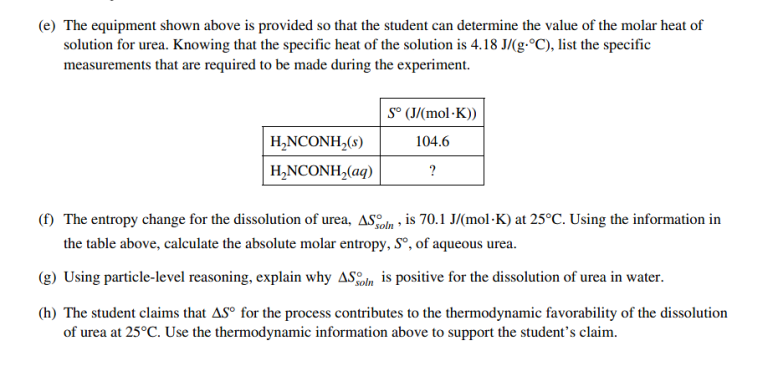
The sixth part asks for entropy change: subtract the reactants’ entropy from the products’ entropy. The result is 175 J mol⁻¹ K⁻¹.
The seventh part concerns the positive entropy change when urea goes from solid to aqueous form: the particles have greater positional dispersal.
The final part concerns Gibbs free energy and uses ΔG = ΔH − TΔS.
A positive ΔS contributes to thermodynamic favorability because the positive quantity TΔS is subtracted from ΔH, making ΔG more negative.
I uploaded the explanation in the video.
Some students arrived near the end, and trying to record quietly made the atmosphere feel rather tired.
I wanted the recording to be lively, so that is disappointing.
You can find the materials through a Google search.
I am also posting information about the answers. Thank you.