Someone asked me to upload these, and I could not simply ignore the request,
so I am posting them in very short sections. Haha.
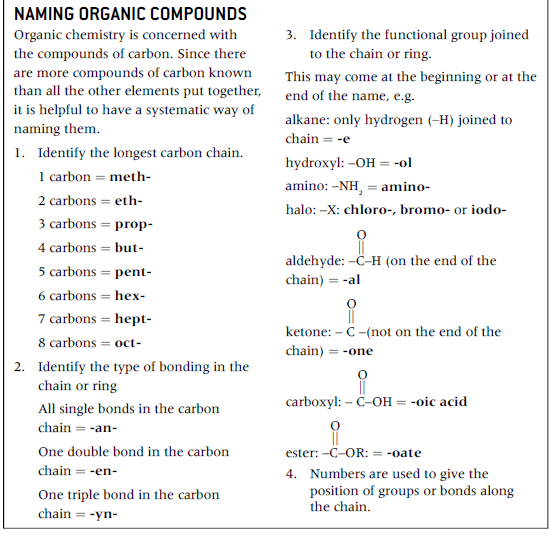
1. Identify the longest carbon chain.
1 carbon = meth-
2 carbons = eth-
3 carbons = prop-
4 carbons = but-
5 carbons = pent-
6 carbons = hex-
7 carbons = hept-
8 carbons = oct-
All single bonds in the carbon
chain = -an-
One double bond in the carbon
chain = -en-
One triple bond in the carbon
chain = -yn-
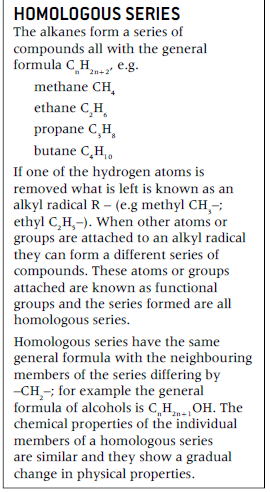
Compounds with the general
formula CₙH₂ₙ₊₂, for example:
methane CH₄
ethane C₂H₆
propane C₃H₈
butane C₄H₁₀
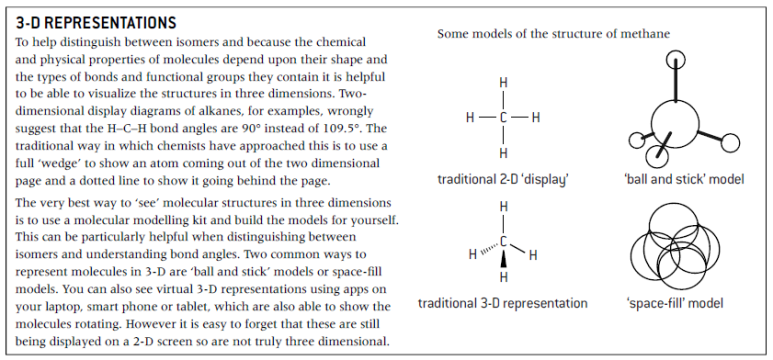
3-D REPRESENTATIONS
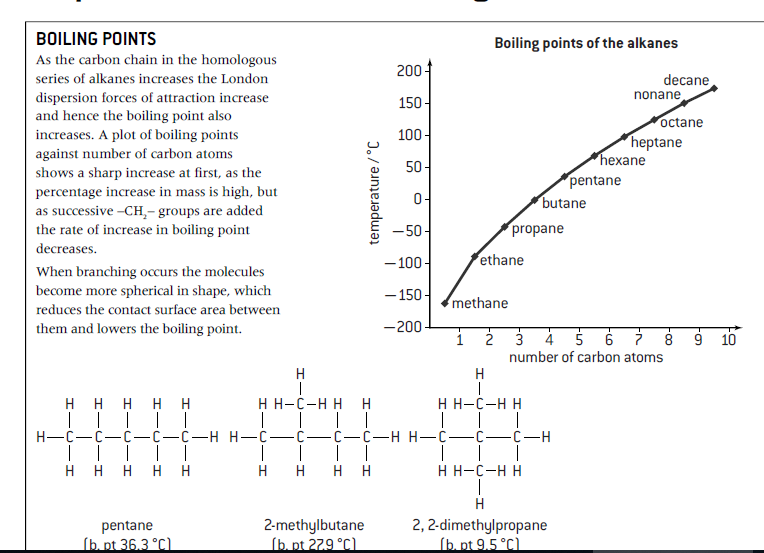
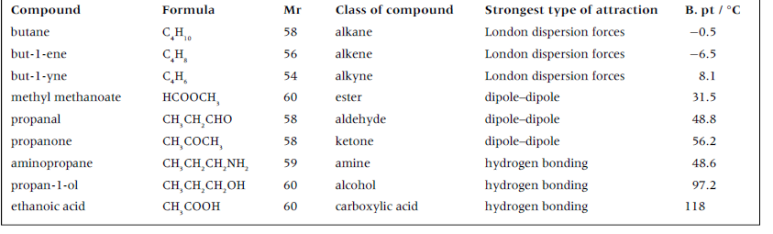
BOILING POINTS
Compound | Formula | Mᵣ | Compound class | Strongest attraction | Boiling point / °C
butane | C₄H₁₀ | 58 | alkane | London dispersion forces | −0.5
but-1-ene | C₄H₈ | 56 | alkene | London dispersion forces | −6.5
but-1-yne | C₄H₆ | 54 | alkyne | London dispersion forces | 8.1
methyl methanoate | HCOOCH₃ | 60 | ester | dipole–dipole | 31.5
propanal | CH₃CH₂CHO | 58 | aldehyde | dipole–dipole | 48.8
propanone | CH₃COCH₃ | 58 | ketone | dipole–dipole | 56.2
propan-1-amine | CH₃CH₂CH₂NH₂ | 59 | amine | hydrogen bonding | 48.6
propan-1-ol | CH₃CH₂CH₂OH | 60 | alcohol | hydrogen bonding | 97.2
ethanoic acid | CH₃COOH | 60 | carboxylic acid | hydrogen bonding | 118
ADDITION REACTIONS
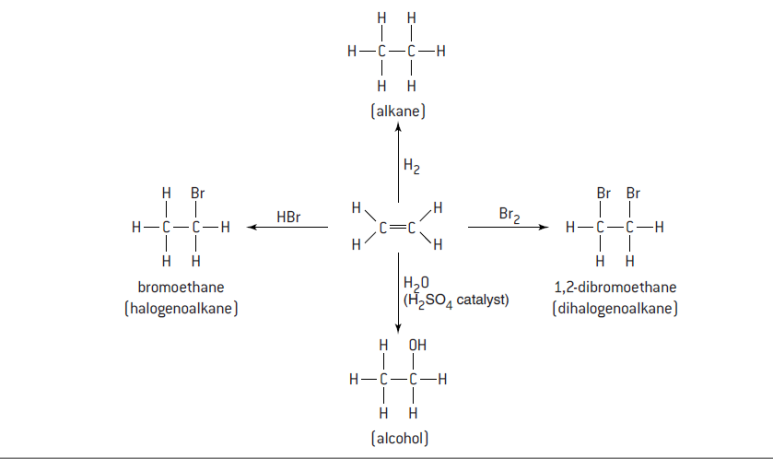
The C=C bond in alkenes has a bond enthalpy of 612 kJ mol⁻¹, which is less than twice
348 kJ mol⁻¹, the average bond enthalpy of a C–C single bond. This helps explain why alkenes react more readily than alkanes. Their characteristic
reactions are additions, in which another molecule adds across the double bond. The alkene is
unsaturated; an addition product with four single bonds around each carbon is saturated.
After teaching five lessons on Sunday—not five hours! Haha—
I kept the momentum going and recorded a little to upload.
I will post more next time.
I recorded on my phone, and the sound is very quiet. Please use earphones if needed.
Organic Chemistry matters in both IB and AP. I will explain the key points in short sections and upload them.