The IA carries considerable weight in IB.
Broadly, the process is:
1. Choose a topic.
2. Carry out the experiment.
3. Write it up.
4. Review it.
5. Learn techniques from examples.
1. Choosing the topic may be the most important step. A good choice makes both the experiment and the analysis easier.
How should you choose? Many students mistakenly think they need an idea that nobody has ever investigated.
One of my students added acids and bases to slime and measured changes in its strength. I was impressed by the idea.
The project concerned boron-containing cross-links in slime and how adding base affected the chemical structure.
But it was difficult to find published data for that exact experiment.
I remember struggling with the analysis. In such cases, papers on similar experiments can help you compare and explain the results.
Does an IA have to be that creative? Absolutely not.
As I will explain below, even that experiment was not a completely unprecedented idea.
A wholly new research idea belongs more to doctoral work; an IA does not demand that level of originality.
But what do students think?
When school assigns them a topic, they start Googling. After searching endlessly without finding a suitable idea, they give up and read Naver webtoons, then watch YouTube, waste time, and feel guilty. I think beginning with an open-ended Google search is the wrong approach.
Where should you look instead?
Look at experiments in past questions or your textbook. Students often object that textbook experiments are too easy for an IA.
But are they? Have they actually examined the experiments in past papers? My answer is that those can be difficult too.
Of course, you should not simply copy one unchanged. Adapt it.
For example, Chemistry kinetics includes experiments such as magnesium reacting with hydrochloric acid to produce hydrogen. Simply reproducing the textbook experiment is not enough, but a small change can create a research direction.
What if, instead of magnesium, you investigated slime as the student above did? That is the kind of thinking that produced the idea.
The acid-and-base slime investigation began with a textbook idea, not a random Google search.
Another example is Biology: you learn where digestive medicines act. You might adapt that idea by comparing a digestive medicine with a plant that aids digestion. Papaya, for instance, contains protein-digesting enzymes, discussed in connection with breaking down insects.
You could ask how those enzymes compare with a digestive medicine. Most ideas are small adaptations of experiments already found in textbooks.
Some websites collect experiments in one place. InThinking is one example.
I think an instructor should help with the search because having students find everything individually takes time. Again, a good instructor matters.
1) Do not make topic selection more grandiose than it needs to be.
2) Look at the textbook before starting with Google.
3) Adapt a textbook experiment to develop your topic.
www.inthinking.com ↗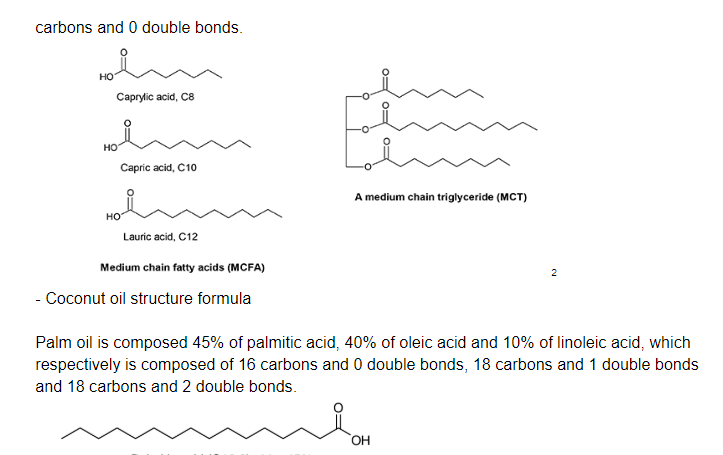
The image above concerns biodiesel. The topic was selected by adapting material from Biochemistry.
2. Carrying out the experiment. Once you have a few possible topics, begin searching online.
Check whether research papers exist on your topic, whether others commonly perform the experiment, and whether published comparison data are available.
I recommend finding a suitable paper and using a similar sequence and method. The procedure itself need not be entirely original. If published research
and student investigations already exist, following the closest suitable, well-defined method is a more dependable approach.
If you cannot find a similar experiment despite extensive searching, I would usually advise against that topic.
It may take too much time: you must design the procedure separately, with little confidence that it will work.
You could end up wasting precious time.
If the first experiment goes wrong and you repeatedly restart, things can become tangled and your confidence may fall. Define the method clearly and anticipate possible errors first. Recording the procedure on video can help preserve what happened. Once you have completed it, do not immediately assume every unexpected result means you must start over. In my experience, repeating the same procedure often gives the same result.
Before experimenting, think about the independent variable, percentage uncertainty, and sources of error. Students usually consider variables but sometimes overlook uncertainty and whether the experiment will yield useful calculations. Planning these makes the write-up more focused. Avoid unnecessarily dividing measurements into many small transfers. For example, repeatedly using a small measuring vessel to make up a larger volume adds measurement uncertainty that can be hard to address afterward.
A common problem afterward is distrust of one’s own experiment. Students do not know whether it was done properly because they did not think it through beforehand. Considering errors and the eventual analysis in advance gives a clearer plan. Otherwise, after writing everything, they may begin saying, “I think this is wrong,” then changing values and eventually replacing the whole account. Be careful about wasting time in that cycle.
1) Consult similar research before experimenting.
2) Think through the analysis as you carry out the work.
3) Once you have carried out the experiment, trust it. The original post even remarks that a little manipulation might creep in, but urges confidence in the experiment.
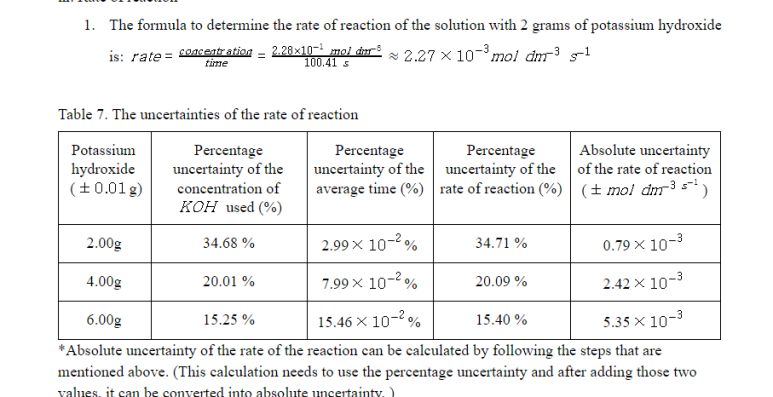
Thinking about data like those above before starting helps the experiment run more smoothly.
3. Writing it up.
First is personal engagement, under the assessment criteria used at the time. It has a relatively small weighting, but you do not want to lose marks immediately because it shapes the first impression. Give a specific reason for selecting the topic: answer “Why did you choose this?”
Few IAs seem to give a truly specific reason. Referring to a paper or textbook can help explain the choice clearly. Rather than vaguely saying you were unwell or interested in something, explain the particular published investigation that prompted you to explore the topic. In established guidance available online,
you will also find advice against filling personal engagement with an autobiographical story.
Personal engagement comes first, and many students find it difficult.
Some get stuck before they have begun. A concise explanation supported by a paper or textbook is enough; there is no need to fill space with your life story. One student described childhood atopic dermatitis, worsening air pollution, and a wish to find a remedy. But in the examples I regard as useful, the connection is made through a research paper or textbook idea that the student wants to investigate more deeply, rather than an extended autobiography.
After personal engagement, write the background information and methodology. Keep the background focused on what is essential to the experiment instead of trying to include everything. Many projects involve Organic Chemistry, so structures and explanations can help. You do not need difficult material for its own sake, although I have found carefully presented diagrams can make an IA look more polished. Focus on one to three central ideas, but do not compress them so far that only you understand them. The reader should follow the explanation on the first reading; use diagrams where helpful. Then explain the necessary procedures and precautions. It is reasonable to consult existing methods, since many experiments are adapted from published work, but describe the procedure appropriate to your own investigation. Do the same with precautions: emphasize hazards and measures specific to the experiment rather than filling the section with every generic statement about goggles and gloves.
Boxes and tables can make the presentation clearer. A table is useful for organizing variables.
Finally comes the crucial analysis. Discuss errors in detail. Where appropriate, calculate percentage error against a theoretical or reference value, estimate random uncertainty, and present percentage uncertainties clearly in tables. Then discuss possible systematic errors and explain their effects.
You can consult papers on similar experiments or ask an instructor about the reasons for discrepancies.
For graphs, I recommend a best-fit line or curve and, where appropriate, discussing R².
Identifying errors also means identifying improvements.
In the improvements section, explain how the weaknesses could be addressed. There is no single fixed answer: understand the cause and describe a practical improvement clearly and concisely.
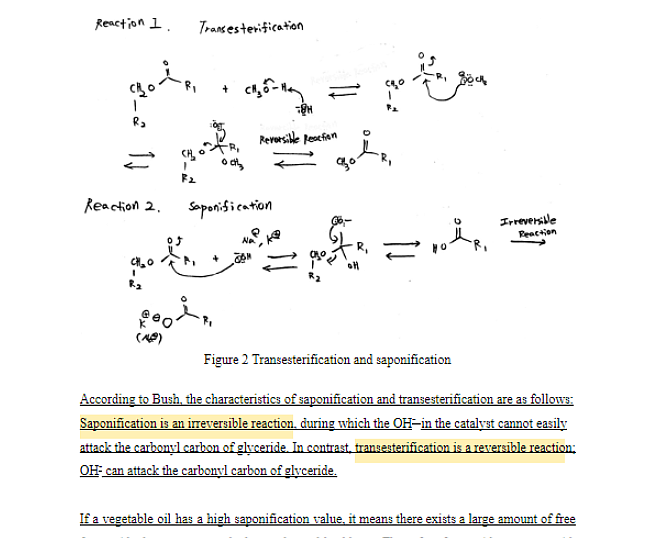
I drew diagrams for the background information to make it look professional. I remember redrawing them because the first version looked messy. Clear presentation is essential. The example above is too untidy; looking at my own drawing now is embarrassing. I think I replaced it, but could not find the final version, so I am showing the one still on my computer.
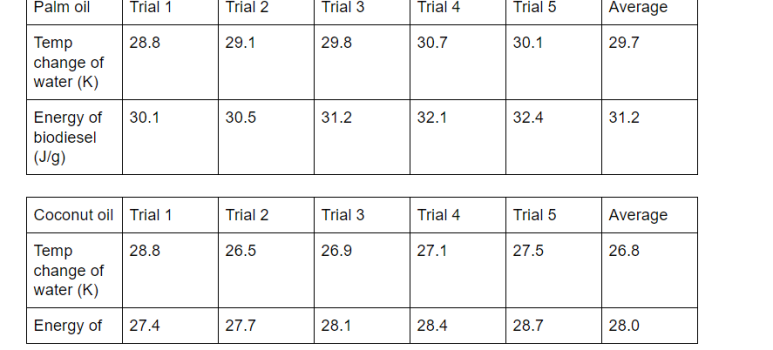
Clear presentation is the lifeblood of an IA. I recommend five trials and including the mean.
Keeping the number of independent variables small also makes the work easier to present.
Two or more can lead to too many tables, so be careful.
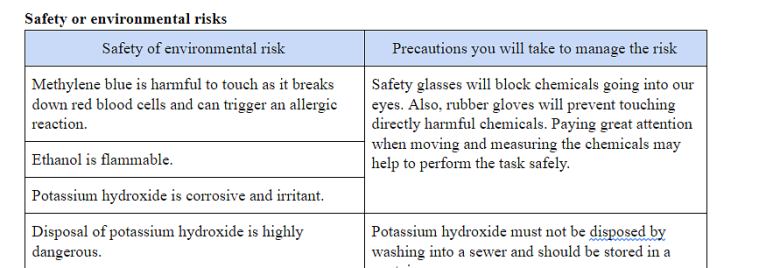
All the materials shown here belong to my students. For precautions too, focus on what directly concerns the experiment.
Do not try to include too much.
1) Personal engagement does not need your whole life story.
2) Consult sources for methodology and precautions, but select and adapt the details relevant to your experiment.
3) In the analysis, discuss errors and explain improvements well.
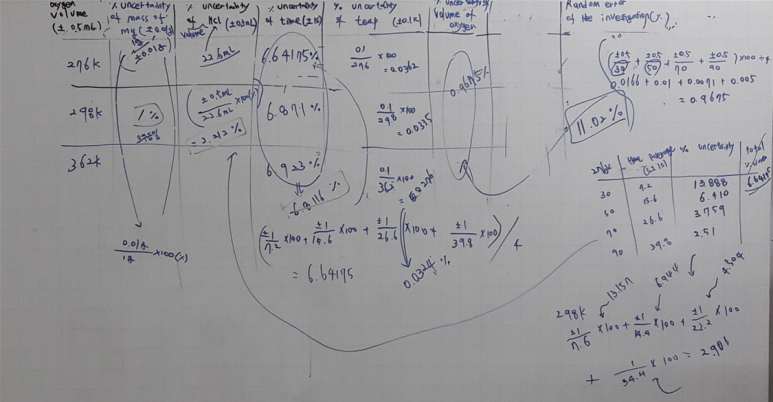
The image above comes from explaining an IA’s analysis to a student. They had calculated no uncertainties, so I worked through them from beginning to end. I remember it as a major reconstruction.
4. Review. Students often dislike this stage most. It means checking both the English and the scientific reasoning throughout. I wonder how easy it is for a student to do alone; a good instructor beside them can be useful.
For English, a language teacher may be much stronger than a science teacher. I sometimes ask an American friend to review the writing. In that respect, a native speaker or English teacher can be more helpful than a science instructor.
After helping with around 50 IAs, you may not instantly distinguish slightly better from slightly weaker work, but truly strong and truly weak work becomes obvious.
The weakest IAs disregard the expected structure. Strong ones look clear at a glance, include equations and percentage uncertainties appropriately, and follow the format. They read smoothly on the first pass—not because the science is trivial, but because the explanation makes it feel accessible.
That takes restraint and the willingness to include only what is needed. Practice writing clearly and concisely so the examiner can follow without difficulty.
------------------
Now let us look at examples.
https://internalassessments.files.wordpress.com/2018/01/wm-joseph-ong-chemistry-ia-watermark-1.pdf
https://internalassessments.files.wordpress.com/2018/01/wm-charmaine-tans-chemistry-ia-watermark-1.pdf
https://internalassessments.files.wordpress.com/2018/02/wm-chemistry-ia-final-risma-remsudeen.pdf
I cannot publish all my own students’ work. Instead, I am linking examples already circulating online and offering my interpretation.
https://internalassessments.files.wordpress.com/2018/01/wm-joseph-ong-chemistry-ia-watermark-1.pdf ↗https://internalassessments.files.wordpress.com/2018/01/wm-charmaine-tans-chemistry-ia-watermark-1.pdf ↗https://internalassessments.files.wordpress.com/2018/02/wm-chemistry-ia-final-risma-remsudeen.pdf ↗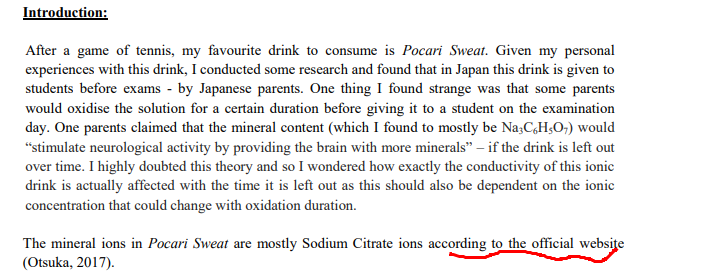
The introduction needs a defensible rationale. In this example, the student proposes that drinking Pocari Sweat improves mental performance and supports the idea with an official website reference, “Otsuka, 2017.” The opening story about playing tennis matters less than that evidence.
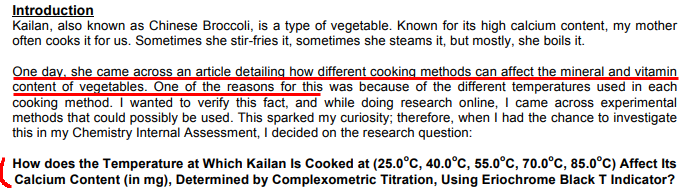
This example also draws its rationale from an article. The opening story about the student’s mother preparing broccoli is not the important part.
I think it would be better to identify the article and where it can be found more clearly.
A question is posed in bold below.
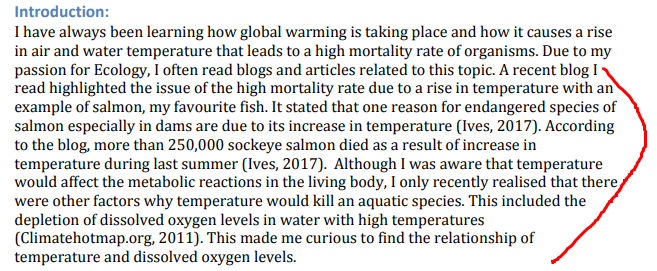
This integrates personal engagement. Students sometimes stop at “I have been unwell since childhood, so I chose this experiment.” The stronger example explains that reading particular papers prompted deeper investigation, and identifies those papers. It also uses the Winkler experiment found in textbooks, so it is not an entirely novel experiment.
That gives a general idea of how to write the introduction.
Next, variables.
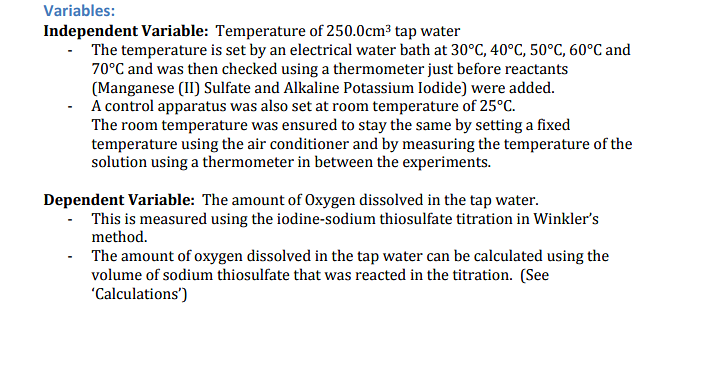
Too many independent variables create problems: the experiment expands and the tables multiply. The IA above sensibly uses temperature as its independent variable. More experiments do not automatically mean better work.
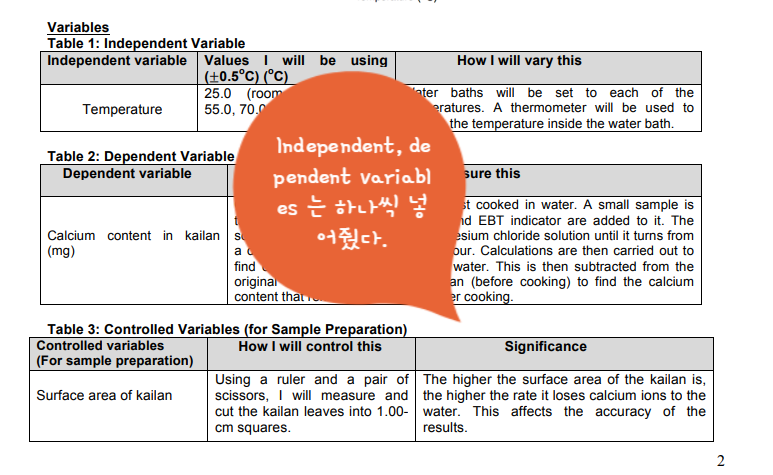
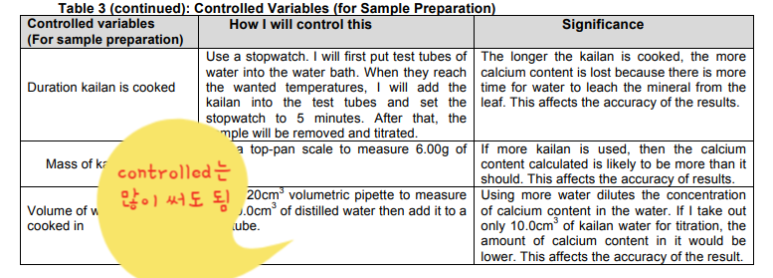
These variables are organized in a table. Tables can look clear, although this particular one is not as tidy as it could be.
My recommendation is to describe the independent and dependent variables in prose
and put the controlled variables in a table.
Again, keep the project focused, with one independent and one dependent variable.
Being overambitious here is not an advantage.
Now, precautions.
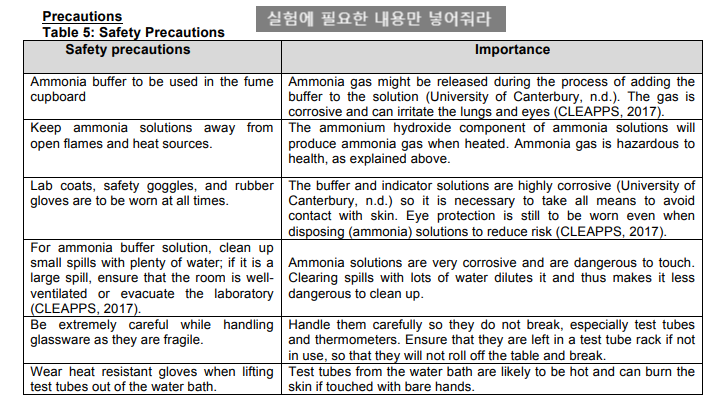
The examples show that this section should not be assembled by thoughtlessly copying generic material from the internet.
Include precautions relevant to the experiment. There is plenty of material online, but select only what applies and adapt it to your own investigation.
Next, graphs.
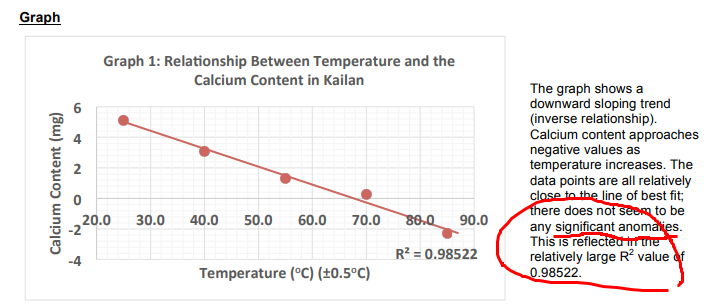
I recommend keeping to one focused graph rather than adding so many that the IA looks cluttered or full of empty space. Include an appropriate best-fit line or curve.
Use the R² value, where appropriate, to support discussion of the fit and anomalous results.
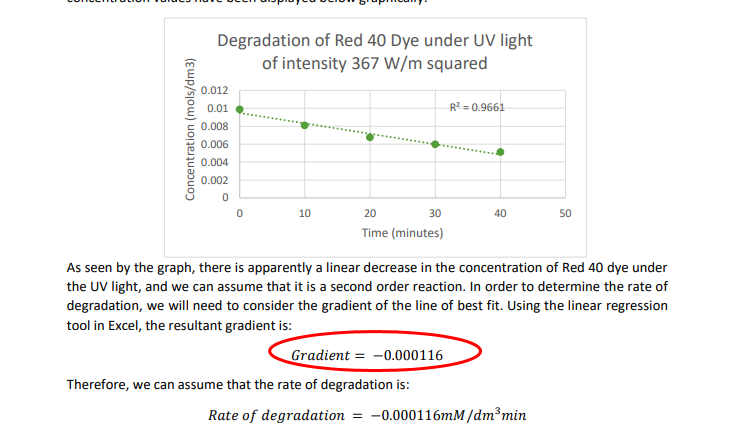
Graphs are often prepared in Excel.
If you obtain a rate from a gradient, state clearly that this is how you calculated it.
Now, errors. Discuss random uncertainty and systematic error. Percentage uncertainty can describe measurement uncertainty, while comparison with published data and percentage error can support a discussion of possible systematic discrepancies.
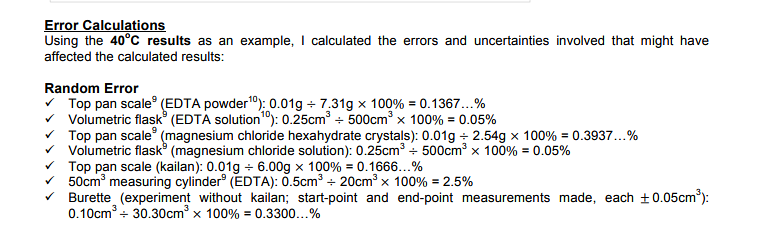
After calculating percentage uncertainty, use the corresponding fractional uncertainty and the final value to find absolute uncertainty. The original post recommends two decimal places for a tidy presentation.
Then finish with the conclusion and evaluation.
Learn the format and understand the approach before you begin writing.
Good luck to everyone working on an IA.
I am continuing to add to this post.
If you have any questions…