Students preparing for IB often study the syllabus separately.
I do not think you necessarily need a lecture just to study the syllabus.
However, beginners may not understand what the entries mean,
so a lesson or an instructor’s help can save considerable mental effort.
I recommend not starting with the syllabus. First, solve enough past questions and read your core textbook
to build your skills; then look at the syllabus.
https://www.ibchem.com/root_pdf/Chemistry_guide_2016.pdf
Here I will look at the guide for the 2016 syllabus. You can download it above.
https://www.ibchem.com/root_pdf/Chemistry_guide_2016.pdf ↗
Let us examine the 2016 syllabus.
Schools often use pre-2016 past questions in tests regardless of the syllabus change.
So students can benefit from pre-2016 questions too. Generally, it is good to solve all the past questions you can.
However, distinguish between material that requires detailed study and material that does not.
Frankly, I am skeptical when someone says they did badly simply because they did not know the syllabus.
So how should you read it?
Download the document linked above and take a look.
The first thing to examine is the contents.
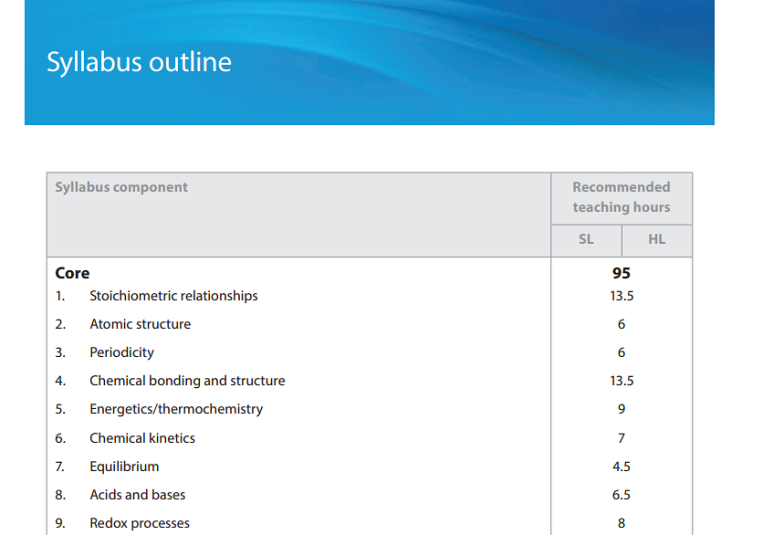
Use it to get a rough sense of the material: “Oh, this topic is included.” Then move on.
You do not need to analyze the contents deeply. More experienced students, however, can take it in at a glance.
After enough IB Chemistry study, you naturally remember the topic order.
Students therefore see the same contents differently depending on their experience.
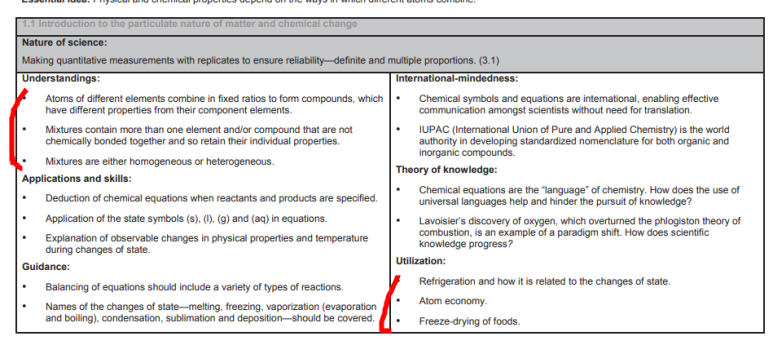
Here is the stoichiometry section. Check for unfamiliar terms.
The “Understandings” are the material taught in the textbook. If you see an unfamiliar word or concept, use the book to fill the gap.
A Google search can also help.
The “Utilization” section may contain unfamiliar material too. If so, look it up and study it.
For example, what does atom economy mean?
Atom economy (%) = mass of atoms in the desired product / mass of atoms in the reactants × 100.
If that concept is unfamiliar, of course you should investigate it.
You can use the textbook or search the exact syllabus term online.
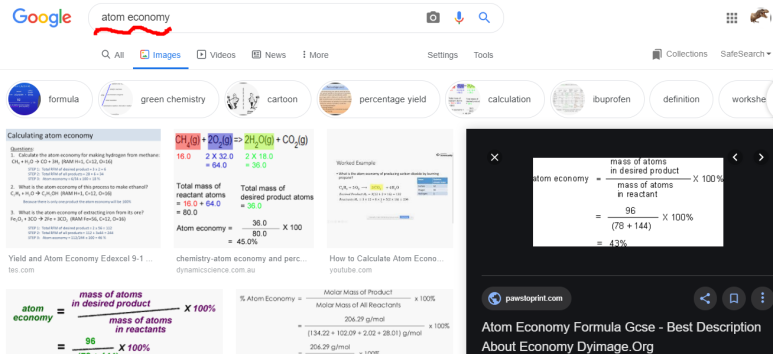
Keep looking until you understand. If you have a good instructor, keep asking questions!
Working through all this carefully is not easy alone. For a beginner, it is almost impossible.
A student with a solid foundation can read it much more easily.
If you want to master the syllabus from the outset, an instructor can help. In practice, studying a core textbook is much the same as studying the syllabus,
so learn the textbook thoroughly, then use the syllabus to resolve gaps or uncertainties.
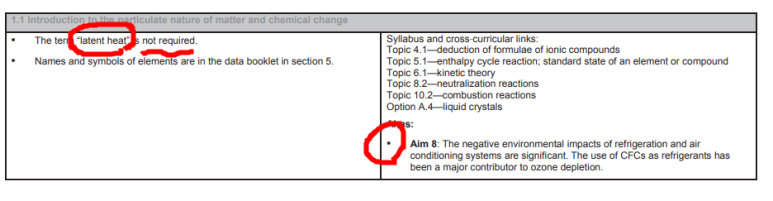
Looking at the example above,
it says that the term “latent heat” is not required.
Some material that can appear in AP Chemistry is not required in IB Chemistry.
With enough question practice and school study, students usually learn to distinguish these areas, so I do not think it is a major problem.
Now look at the aims. The example mentions Aim 8. What is that?
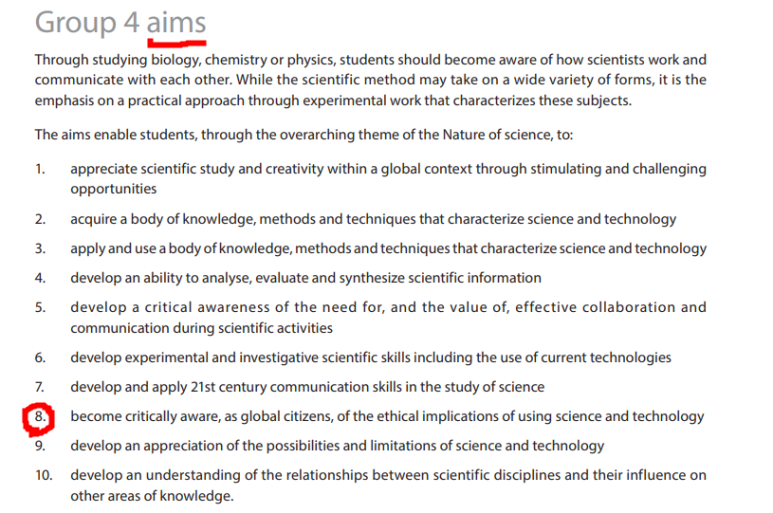
The guide explains the aims. Look at number 8.
8. Develop, as global citizens, a critical awareness of the ethical implications of science and technology.
That is the idea expressed there.

You are asked to consider it within the Group 4 sciences.
Read the guide’s explanation of Aim 8.
Knowing the Chemistry syllabus this way helps you anticipate the material that can be tested.
But reading it from the very beginning of your studies is not easy.
Once you have solved a reasonable number of past questions and learned the basics, it makes much more sense.
I recommend reading it after you have completed some study.
Alternatively, read the relevant section after practicing a topic sufficiently.
Not reading the syllabus does not automatically mean you will do badly, so do not worry excessively if you have not read it.
But I recommend it for a more precise understanding of what to study.