Choosing a topic
Hello, this is JjangJi. In some ways, choosing the topic may be the most important part of an IA.
A well-chosen topic makes both the experiment and the analysis easier. But do you really have to put so much effort into performing the experiment perfectly? I have some thoughts on that below.
So how do you choose? Many students mistakenly think they must find a topic nobody in the world has explored.
One student added acid and base to slime and measured its strength. I was amazed that they had come up with that idea.
The idea concerned the boron-containing structure in slime and chemical changes when base was added.
But we couldn't find published data directly matching that experiment.
I remember the analysis being difficult for that reason. In such cases, papers on similar experiments can help you compare and explain the results.
Does that mean only such creative experiments can be chosen? Absolutely not.
An entirely unprecedented idea belongs at the level of doctoral research; an IA doesn't require that. Some creative ideas also don't suit a Chemistry IA well—for example, experiments whose results can only be presented as a bar chart.
Then how should students choose their IA topic?
When the school assigns topic selection, students often begin by searching Google. They waste time finding nothing and blame themselves. Starting with a broad search can feel like looking for a pearl in a rubbish heap. So where should you look?
There isn't one definitive answer. My recommendation is to begin by downloading and reading the IA examples on my website.
IB Chemistry — JjangJi, aplecture.com. I posted several Chemistry IA examples there.
IB Biology Information — JjangJi Chemistry, aplecture.com. I posted Biology IA examples there.
Another site I recommend is https://www.clastify.com/profile. Please use the examples to practice.
Most student Chemistry and Biology IAs don't stray far from course content, and that isn't a bad thing.
For example, the Chemistry kinetics material includes experiments such as reacting Mg with HCl to produce hydrogen gas.
Because that experiment appears in the textbook, students usually modify it rather than reproduce it unchanged. But the adaptation still stays close to the course.
One example would be extending that experiment using the Arrhenius equation.
In Biology, students learn how digestive medicines help digestion. An adaptation might compare those medicines with plants associated with digestion to see whether they have a similar effect.
Or consider papaya's digestive enzyme, described here as a substance that can break down insects. Comparing that enzyme with a digestive medicine could become a topic.
These ideas mostly come from textbook material connected to everyday life.
Some websites collect experiments together, including www.inthinking.com. Personally, I prefer the site recommended above.
A good topic isn't something even a tutor like me can simply choose for you. Read many earlier students' topics, think carefully, and work toward your own choice.
Here are a few rules I use when thinking about topic selection.
1) Don't make the topic grander than it needs to be.
2) Read earlier students' IAs before selecting a topic.
3) Try connecting textbook experiments with real life.
https://www.clastify.com/profile ↗www.inthinking.com ↗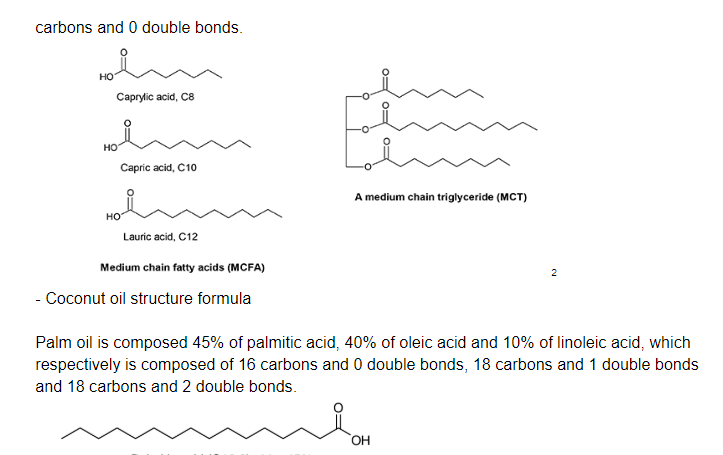
Topic choice is so important in Chemistry and Biology IAs that it can feel like everything depends on it. It is no exaggeration to say this deserves very careful work.
Conducting the experiment: once you have a few possible topics, begin targeted searches.
Check whether papers exist on your topic, whether the experiment is commonly performed, and whether published data are available.
I recommend finding a suitable paper and using a similar procedure. The experimental method doesn't need to be entirely original either. If papers and student examples already exist, choose the most relevant and reliable method as a starting point. If you cannot find anything similar despite searching, I would advise against that experiment. It could take too much time to devise a method from scratch, and you may have little confidence that it will work. That can waste valuable time.
Few things seem more frustrating than repeatedly redoing an experiment because the first attempt went wrong. Let me be frank: does the experiment absolutely have to be precise? If you understand it reasonably well, you may be able to predict approximate values. If one or two exceptions were inserted, could a marker tell whether the experiment had actually been done? I'll leave that question for the student to answer. I even find myself advising students not to devote too much effort to the experiment. Yet, because this is a post about Chemistry and Biology IAs, I end up writing that they should work hard on it. Read the following comments with that perspective in mind.
Anyway, if the experiment becomes tangled, you lose confidence and progress slows dramatically. Set out a clear method, anticipate possible errors, and then carry it out.
Recording the whole experiment on video can help keep a clear record. Once you've performed it, have confidence in what you did. It's easy to find reasons why it didn't go well and should be repeated, but in my experience, repeating it often produces the same result.
Before experimenting, think about independent variables, percentage uncertainty, and errors. Students usually consider the variables but often overlook uncertainty and error. Check that the experiment will produce quantities you can calculate and analyze; that makes the later IA more coherent. Please define the independent and dependent variables clearly before starting. Also consider the uncertainty introduced by repeatedly using apparatus to make up a quantity. For example, using an instrument several times to reach a target volume can accumulate measurement uncertainty. Such issues are harder to address afterward, so plan for them.
A common problem after the experiment is losing confidence in it. Students aren't sure whether what they did was right because they didn't think through it beforehand. You may ask who would do that, but it can happen to you too.
Thinking about errors in advance helps you conduct the experiment more clearly. Consider the analysis and other aspects before starting. If you lose trust in the experiment, you may finish the report and then begin saying, 'I think this is wrong,' changing values, and eventually rewriting it into something entirely different. Always be careful about wasting time.
I'll also say this frankly: if a student writes well, the IA they fear so much can be drafted in a day under my guidance, although revisions and corrections will still remain, haha.
To summarize:
1) Consult papers describing similar work before experimenting.
2) Think through some of the analysis as you conduct the experiment.
3) Once you've done the experiment, trust it. There may be a little adjustment involved, but begin by trusting it.
4) Don't overwork the experiment. I can't explain that fully here—it's difficult to be precise in a public post, haha.
Writing a Chemistry or Biology IA
First comes Personal Engagement in the rubric discussed here. It doesn't carry many marks, but you don't want to lose marks at the start because it shapes the overall impression. Give a specific reason for choosing the topic. In short, answer: why did you choose this? Many IAs don't explain that clearly. Citing a paper or textbook can help establish the rationale—for example, explaining that an experiment described there made you want to investigate a particular aspect.
Don't fill a whole page with a long personal story. This isn't an autobiography, haha. Keep it brief, but explain why you conducted the experiment and how the investigation might be useful in the wider world. Because Personal Engagement comes first, many students get stuck before they even begin. They don't know what to write, and sometimes I find it difficult too. If you're stuck, use a relevant paper or textbook as a concise starting point: you read a particular study, wanted to investigate something, and thought it might help in a particular context.
You don't need to fill the space with your life story. For example, one student explained that having atopic dermatitis since childhood had prompted an interest in the topic, and that worsening air pollution made them wonder about possible ways to address it. That's a useful rationale.
But expanding it enthusiastically into a full page is unhelpful. I recommend keeping Personal Engagement short; its mark allocation is relatively small.
After Personal Engagement, write the Background Information and Methodology. In the background, focus on what is central to the experiment and resist the urge to include everything. Many experiments involve Organic Chemistry, so drawing and explaining the relevant structures can help. You don't need unnecessarily difficult content—include the essential information. In my experience, though, suitable technical diagrams can make an IA look more polished. Background Information is not simply your own opinion: you need sources for information. Cite them
properly when incorporating the material. One to three focused background subsections can work well, but excessive compression can leave only you understanding the text and force the marker to reinterpret it. Avoid that. Explain sufficiently and use diagrams if needed, as clearly as though teaching a beginner. The reader should understand on the first pass. For Methodology too, if you haven't devised the method yourself, incorporate the relevant source carefully. Reading earlier students' IAs helps you see how to present a method
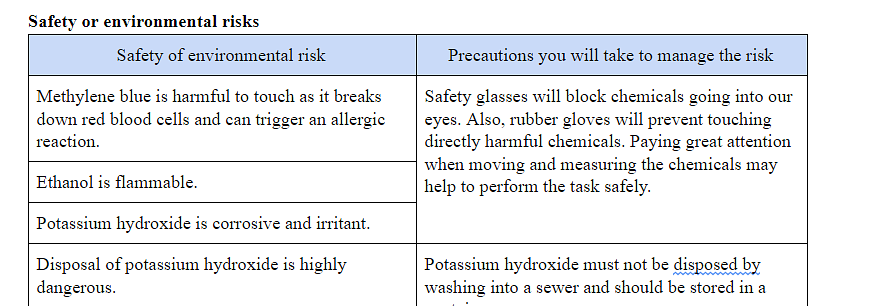
clearly. Procedures are widely available online because many investigations build on existing experiments; refer to them and adapt the method to your own work. Similarly, consult sources for precautions and tailor them to your experiment. Avoid filling the section with obvious generalities. For example, students are already taught to use goggles and gloves; I question whether every standard precaution needs repeating. Focus on precautions specific to the investigation. Listing every possible precaution doesn't create a good impression.
Appropriate tables and boxes can make the presentation clearer. Variables often work well in a table. Check that rows or boxes aren't cut off at page boundaries; layout problems can cost marks. If you know what I mean, you've probably dealt with this before.
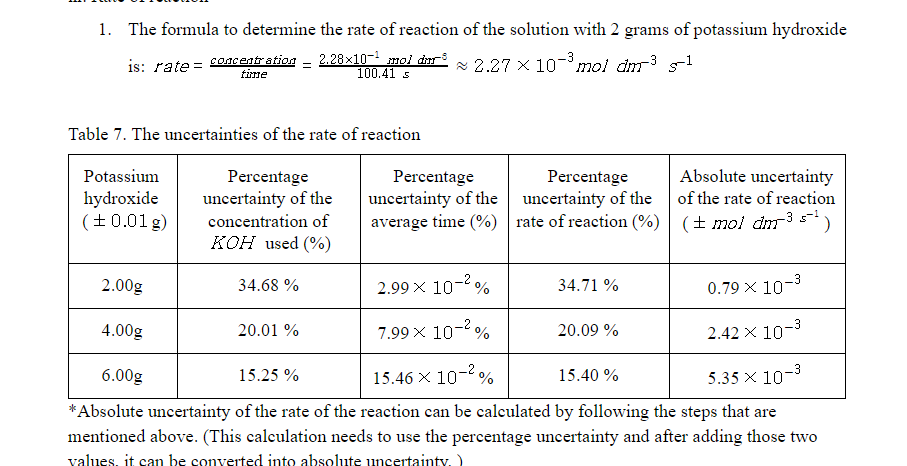
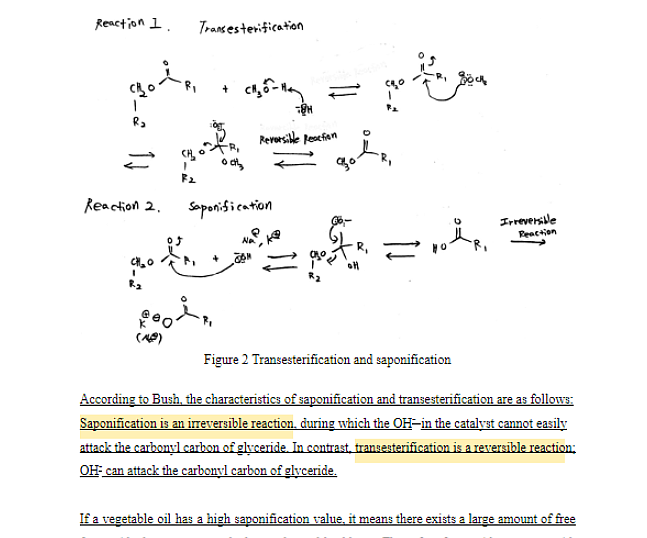
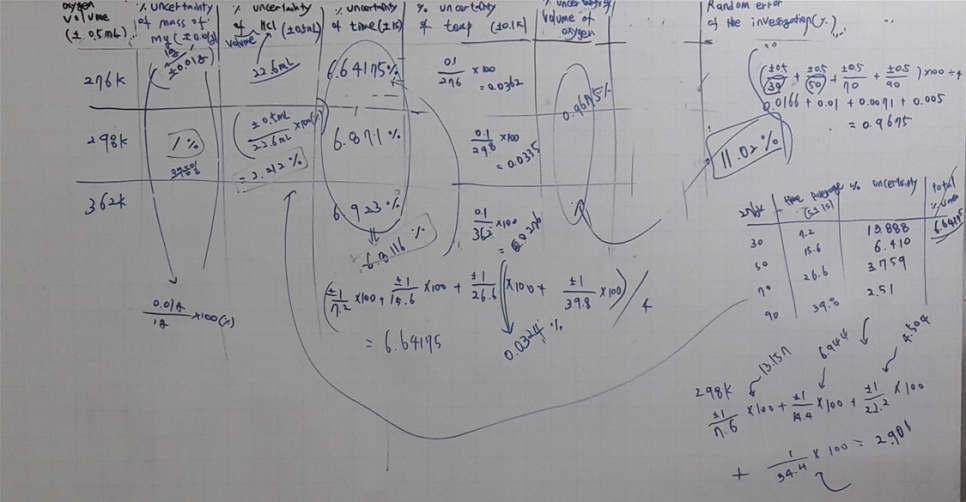
Then comes the most important part: Analysis. Discuss errors thoroughly. For percentage error, try comparing with a theoretical value or yield. Estimate random error and percentage uncertainty and present the experimental uncertainties clearly in tables.
After considering random error, explain systematic error as well.
To understand the reasons for errors, consult papers on similar experiments or discuss them with your teacher.
For graphs, include an appropriate best-fit line and explain the R² value. Discussing errors should also lead to explaining improvements.
There is a lot to write in Analysis. It helps to think of it as bringing together and explaining the calculations you've performed.
In Improvements, there isn't one fixed answer. Identify why the errors occurred, then explain clearly and concisely how they could be reduced.
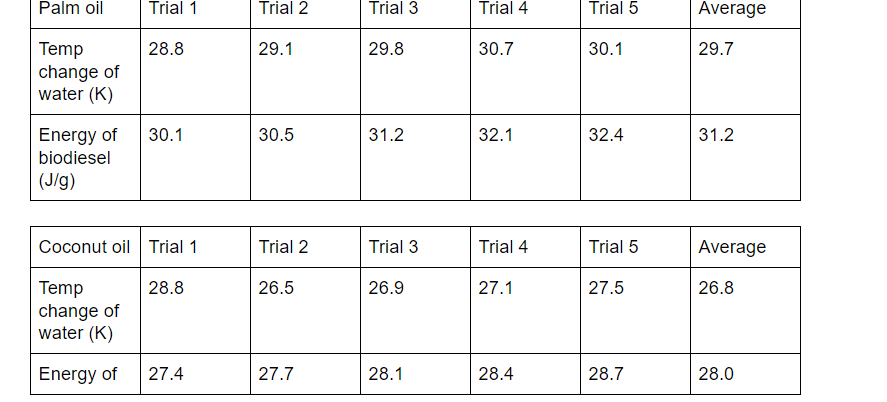
Clear presentation is vital in an IA. I recommend five trials and including the mean.
Use significant figures consistently with what you've learned in the textbook. Correcting them one by one later is tiring.
For the independent variable, five values of one variable make a clear design.
Using two or more independent variables can create too many tables, so be careful.
1) Don't make Personal Engagement an extended life story.
2) In Methodology and Precautions, use references but don't copy everything; include what specifically applies to your experiment.
3) In Analysis, discuss errors and explain improvements well.
Reviewing the work
This is often the task students least want to do: checking the English, scientific theory, and report as a whole. I wonder how fully students can do that alone. A good teacher beside them can be valuable.
For English writing, an English teacher may be more helpful than a science teacher. I sometimes ask an American friend to look over the language, and that language-focused feedback is useful.
After helping with around 50 IAs, you may not always distinguish slightly stronger from slightly weaker work immediately, but very weak and very strong reports are recognizable at a glance.
Very weak work often ignores the format set out by the IB. Strong work looks clear, presents equations and percentage uncertainty properly, and follows the structure well. It also reads smoothly on the first pass. It doesn't read well because the content is easy; it feels easy because the writing is good.
Writing that kind of IA requires the judgment to let go of unnecessary material and include only what is needed. Practice concise, clear writing so the marker can follow it without difficulty.
Let's examine some examples.
https://internalassessments.files.wordpress.com/2018/01/wm-joseph-ong-chemistry-ia-watermark-1.pdf
https://internalassessments.files.wordpress.com/2018/01/wm-charmaine-tans-chemistry-ia-watermark-1.pdf
https://internalassessments.files.wordpress.com/2018/02/wm-chemistry-ia-final-risma-remsudeen.pdf
I can't publicly share all my students' work. These examples were already circulating online, so I'm sharing them and offering my interpretation.
https://internalassessments.files.wordpress.com/2018/01/wm-joseph-ong-chemistry-ia-watermark-1.pdf ↗https://internalassessments.files.wordpress.com/2018/01/wm-charmaine-tans-chemistry-ia-watermark-1.pdf ↗https://internalassessments.files.wordpress.com/2018/02/wm-chemistry-ia-final-risma-remsudeen.pdf ↗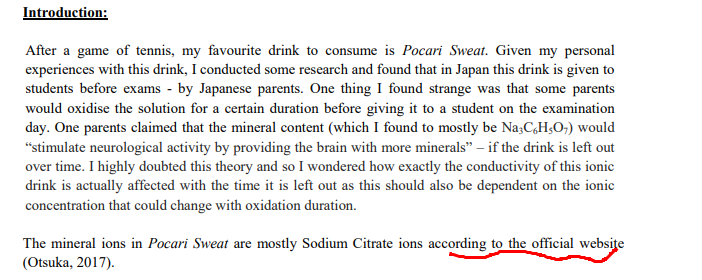
This is an Introduction, and its rationale needs support. The student proposed that drinking Pocari Sweat could improve mental performance and supported the context with an official website, citing Otsuka (2017). The earlier story about playing tennis isn't the important part.
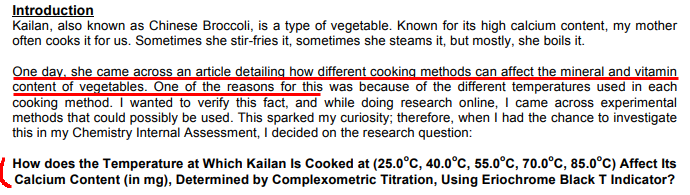
Here too, the rationale comes from an article. The opening story about the student's mother cooking broccoli isn't the main point.
It would be better to identify the article and where it can be found more clearly.
Below, a question is presented in bold.
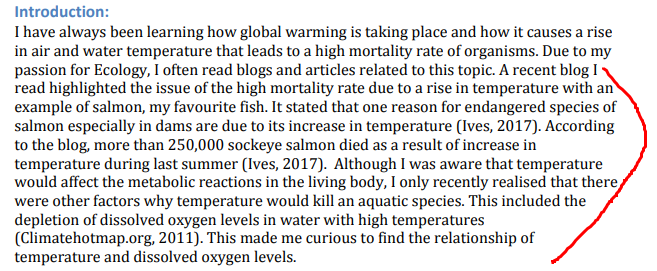
Personal engagement is integrated into this example. Students sometimes think it is enough to say they were ill as children and therefore chose the experiment. The example above works better because it describes reading papers and wanting to investigate further, with the paper's title or location identified. It also uses the Winkler experiment from the textbook, so it isn't an entirely unprecedented investigation.
That gives a broad idea of how to write the Introduction.
Next, let's discuss variables.
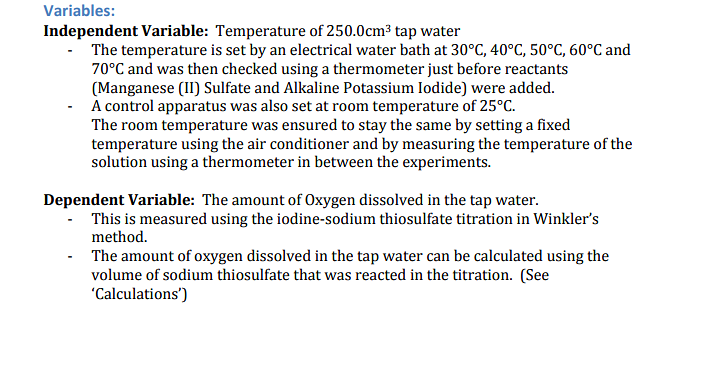
Too many independent variables create problems: the experimental workload grows and more tables are needed. In the IA above, the student kept the scope focused on temperature. More experiments aren't automatically better.

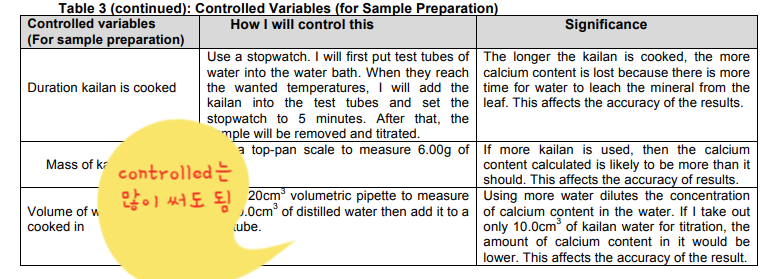
Here the variables are organized in a table. Tables can look clear, although this particular one isn't especially polished.
My recommendation is to describe the independent and dependent variables in text
and present the controlled variables in a table.
Again, keep the scope focused and choose one independent and one dependent variable.
Being more ambitious isn't automatically better here.
Now, let's discuss precautions.
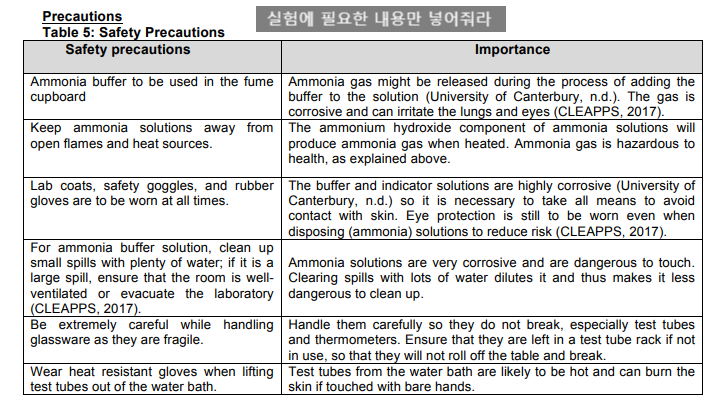
What the example shows is that you shouldn't simply paste general precautions from the internet without thinking.
It includes only precautions relevant to the experiment. Don't add unrelated material. Since precaution information is widely available, select the relevant points and adapt them to your investigation.
Next, graphs.
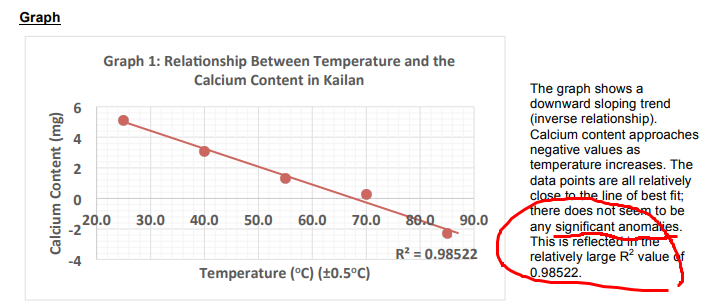
I recommend one focused graph rather than many unnecessary ones. Too many can make the IA look cluttered yet oddly empty overall. Include an appropriate best-fit line.
Use the R² from the fit to support discussion of the fit, reliability, and anomalous results.
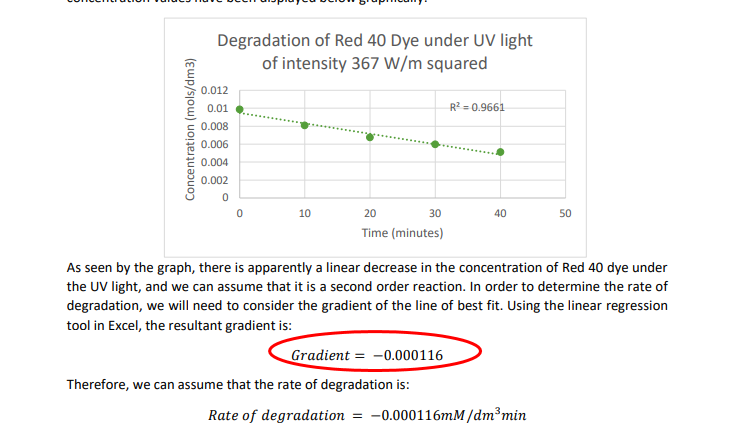
Graphs are often produced in Excel.
If you determine a rate, explain explicitly that it is obtained from the gradient, as shown above.
Now, errors. Consider both random and systematic error. Percentage uncertainty can support the discussion of random measurement uncertainty, while percentage error against published data can help discuss possible systematic differences.
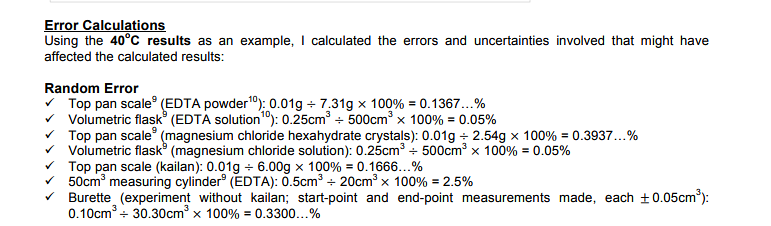
After calculating percentage uncertainty, convert it to a fraction and multiply by the final quantity to obtain absolute uncertainty. The original post recommends presenting values to two decimal places for a neat appearance.
Then write the Conclusion and Evaluation to finish.
Understand the format and think through your approach before beginning the IA.
Good luck, everyone. I hope your IA writing goes well.
I am continuing to add material.
If you have any questions,
Thank you—this was JjangJi. I've reposted an updated version of an earlier article about Chemistry and Biology IAs. Study hard, and thank you.